© 2026 Cerita Rakyat: Tales of the Olden. All rights reserved.
A storytelling card project inspired by Indonesian folklore traditions.
An interactive storytelling card game inspired by traditional Indonesian folklores. Immerse yourself in engaging gameplay.
Cerita Rakyat: Tales of the Olden
Cerita Rakyat: Tales of the Olden

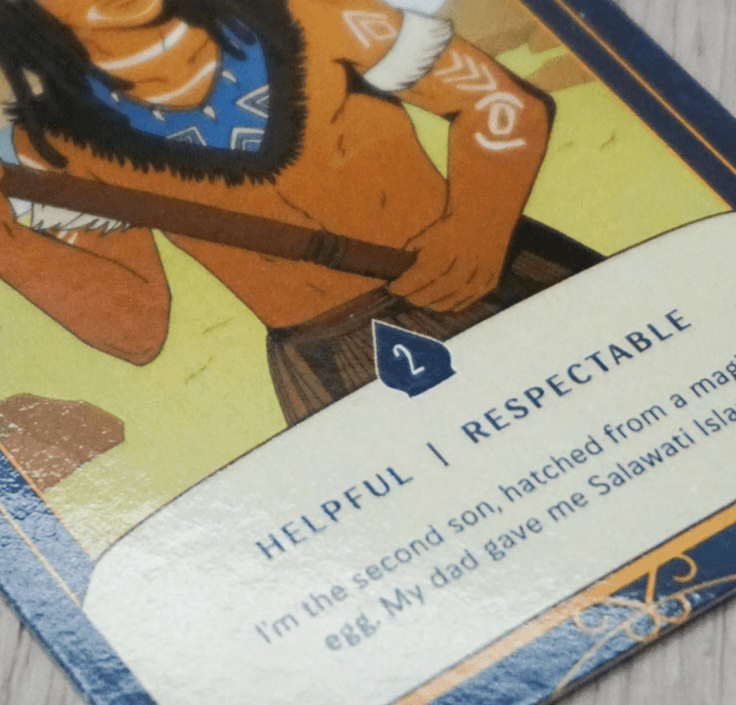
The amount of times a character card must be used before it is considered discarded from a player’s deck.
Activation Numbers

Serves as the guidebook for players to understand each character’s background and role in their folklore.
Folktionary

With a total of twenty narrative cards, these cards provide each round of the game with a beginning and an ending.
Narrative Cards
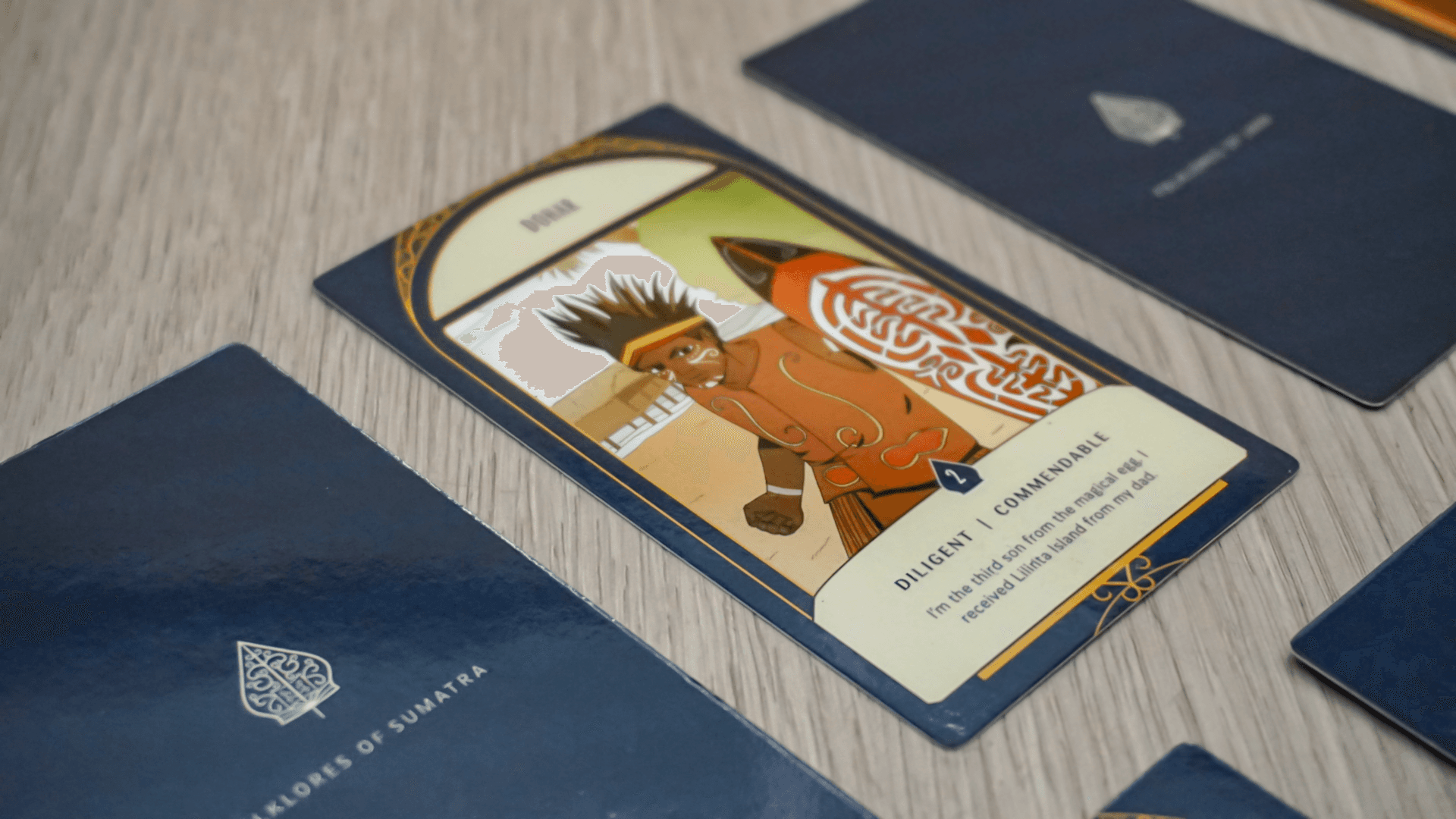
There are a total of forty character cards. Each card holds information of the character’s name, personality, description, and activation number.
Character Cards
Game Components
The first player to discard all of their Character Cards is declared the winner. The last player standing must then create the final ending of the story and conclude it based on the narrative for all players. This makes the last player as the story closer, even though they lost.
Winning Condition
Cerita Rakyat is a storytelling card game based on Indonesian folklore where players must create their own stories based on a narrative card using different folklore characters. Match the plot with the narrative, make sure to be quick-witted when making up stories, and ensure the characters do not stray from their personality.
Player count: 5-8 players.
Introduction

Gameplay
Always persist and be diligent in your responsibilities.
Moral Value
On the bank of Tami River, in Papua, a man named Towjatuwa stood anxiously for his pregnant old wife. The only way to deliver the baby safely is by operating on her using a sharp stone from the river. When searching for the stone, Towjatuwa started hearing sounds behind him. When he looked back, he was startled to see an enormous crocodile, slowly stalking towards him. Towjatuwa was terrified because the crocodile looked unnatural with its back growing with the fur of the Cassowary bird.
But when Towjatuwa was about to flee, the crocodile spoke kindly and introduced itself as Watuwe, asking Towjatuwa what he was searching for in the river. Towjatuwa told his worries about his wife. Watuwe, who was generous, told him not to worry and that he would visit their house at night to help Towjatuwa’s wife give birth.
Happily, Towjatuwa returned home and told the magical encounter to his wife. True to Watuwe’s words, that same night, Watuwe came to help them. They gave birth to a baby boy named Narrowra. Watuwe predicted that Narrowra would become a skilled hunter. This help came with a condition that they must not consume crocodile’s meat or else, their descendants will die. Towjatuwa and his family kept this promise, looking after the animals that lived near the Tami River from hunters.

Watuwe

Towjatuma
South Sulawesi
Watuwe si Buaya Ajaib [Watuwe the Magical Crocodile]
Be faithful and loyal in your responsibilities.
Moral Value
The story of Ampat Raja tells of the origins of the Raja Ampat region in Papua. It began with a couple longing for a child who, during a rainy season, while gathering firewood, discovers six large eggs by the Waikeo river. Five of the eggs hatched and produced four boys—War, Betani, Dohar, and Mohamad—and one girl, Pintolee, while one egg turned to stone. Grateful for the blessing, the couple raised their children diligently.
However, Pintolee chose to marry against her family's wishes and sailed away on a giant clam shell, stranded on Numfor Island. Despite her absence, her brothers supported their parents and later inherited islands from their father: War received Waigeo Island, Betani got Salawati Island, Dohar was given Lilinta Island, and Mohamad received Waiga Island.
The brothers successfully cultivated their respective islands into prosperous realms. The stone from the unhatched egg, named Kapatnai, is revered as a king by the local people, safeguarded in a special room alongside two menhir stones, Man Moro and Man Metem, at the Kali Raja Historical Site in Raja Ampat. The stone's sanctity allows public view only once a year during specific ceremonies conducted by the royal lineage.
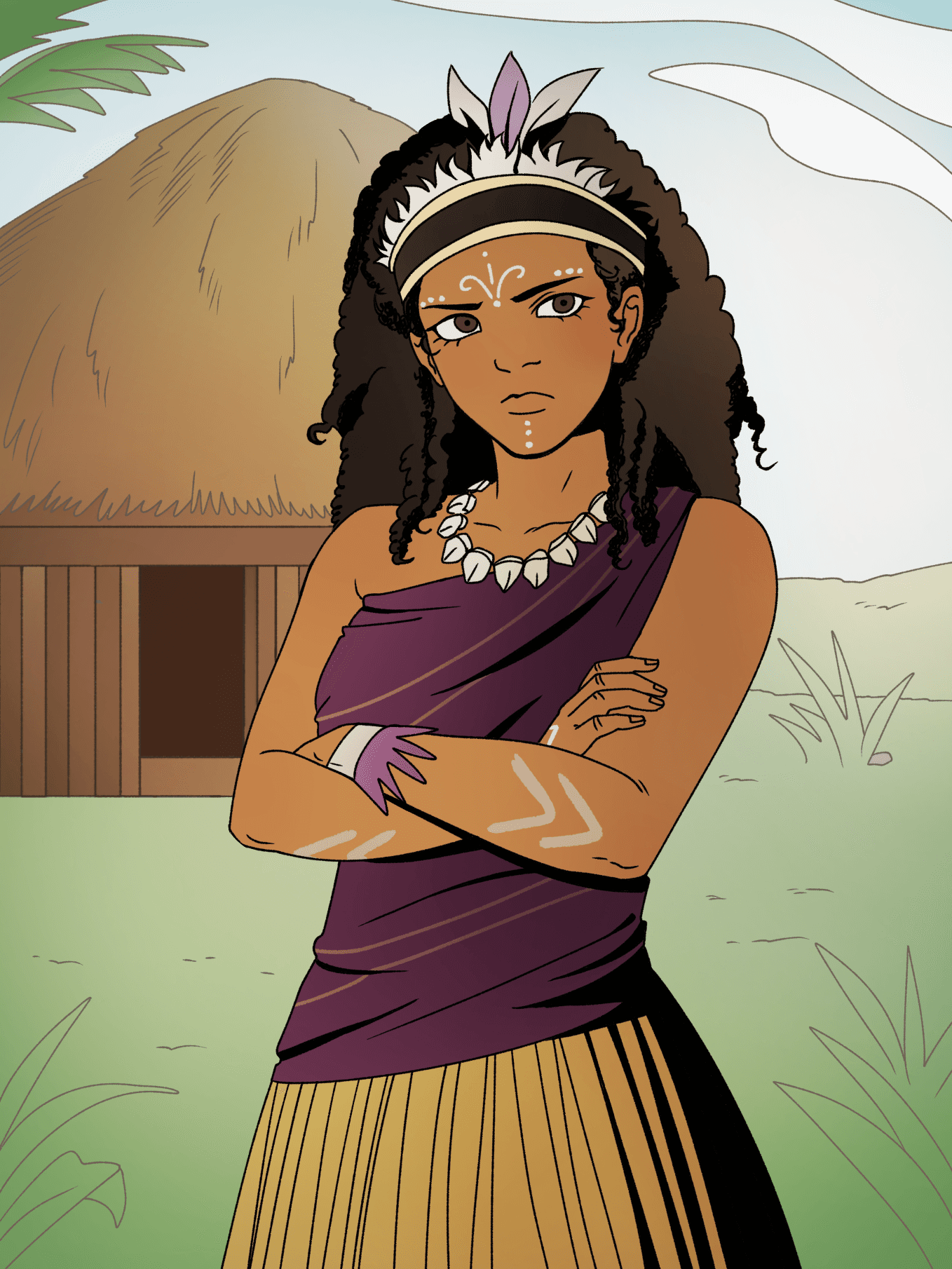
Pintolee

Mohamad
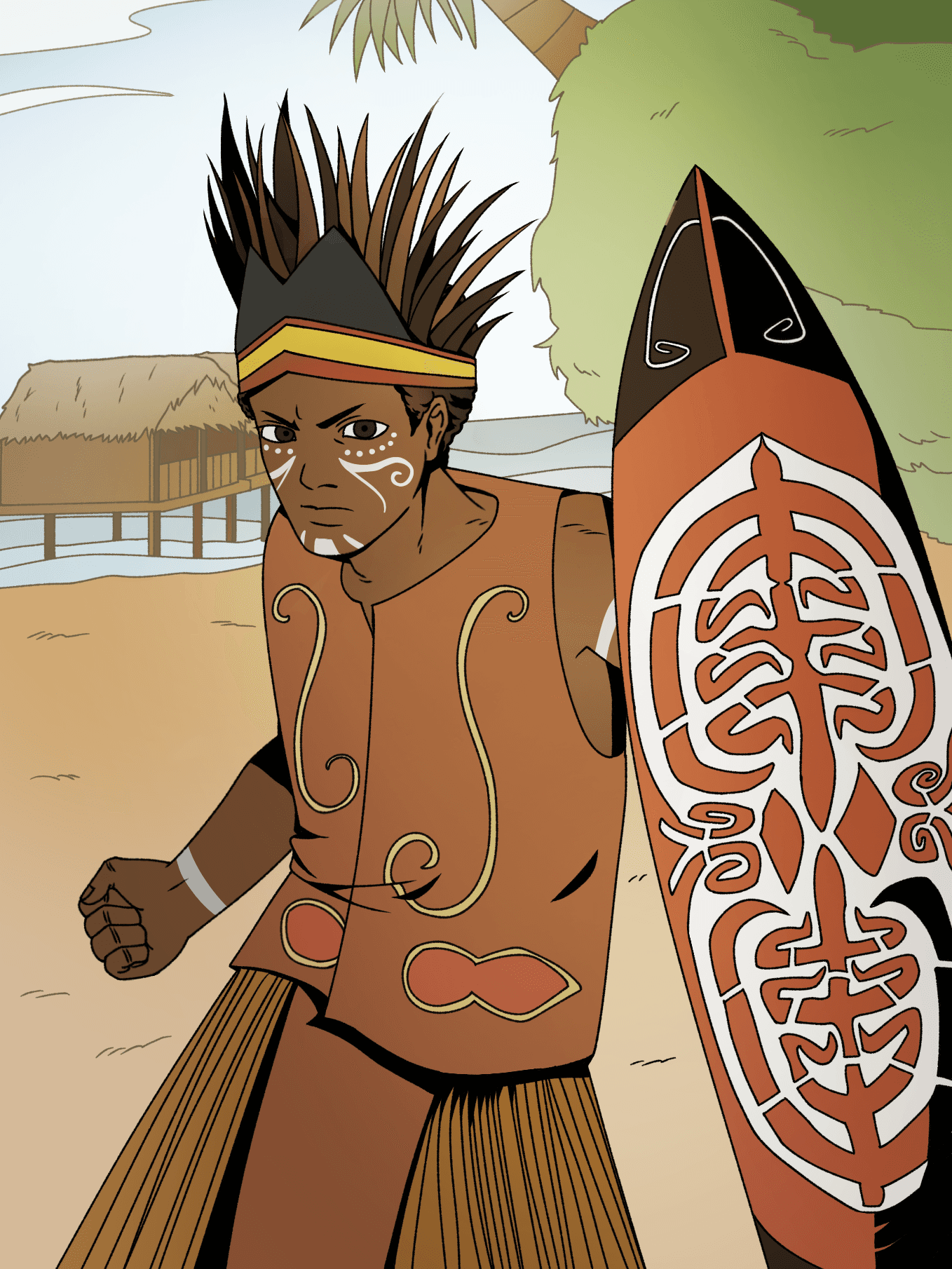
Dohar

Betani

War
Raja Ampat
AMPAT RAJA
With bravery and perseverance, troubles can be overcome.
Moral Value
In a prosperous village in Mimika, the people relied on sago to live. One day, as the sago supply started dwindling, they traveled to the forest, crossing a large river to search for more sago. During the journey, they encountered an enormous dragon who killed everyone except one pregnant woman, who fled and survived in the forest. Eventually, she gave birth to a son named Biwar.
One day, Biwar asked his mother for permission to hunt in the forest. His mother agreed, but did not allow him to go near the big river. Curious, Biwar disobeyed and found that the fishes were much larger, so he fished there. His mother realized the fishes were larger than their usual ones and confronted him, prompting Biwar to confess that he fished in the big river. Biwar’s mother then explained the devastating story of how the dragon killed the villagers, including Biwar’s father. Filled with anger, he kept on pushing his mother to let him kill the dragon.
Though at first his mother disagreed, Biwar was adamant and so she agreed to his request. Biwar left with an arrow and a spear, leaving his mother worried. In the river, he challenged the dragon and started attacking it but the dragon was not at all affected by Biwar’s weapons. Thinking quickly, Biwar ran to the cliff and when the dragon was about to blast a huge fire from its mouth, Biwar pushed a giant rock to its head. The rock hit its head and killed the dragon at once. With the defeat of the dragon, they decided to return to their village. They told the stories of how they survived and how Biwar conquered the dragon.

The Dragon

Biwar
Mimika
BIWAR SANG PENAKLUK NAGA [BIWAR THE DRAGON CONQUEROR]
PAPUA

There is always a way out when thinking clearly and wisely.
Moral Value
Rumors about Nenek Pakande were already heard as she is known for having magical power using witchcraft, but to preserve her power, she needs to constantly consume children. She traveled across villages to prey on children and at last, she arrived at the Soppeng regency.
One afternoon, as the sun was setting, two brothers were still playing outside and didn’t listen to their mother who told them to go inside before it was dark. Nenek Pakande, who was secretly spying, quickly kidnapped them. When the mother came back outside, she was stunned to find her children missing. Her hysterical shouts drew the neighbors’ attention, who helped her find the boys, albeit unsuccessfully.
The village was gathered to find the boys when another woman came crying, saying that her baby had gone missing. Suddenly, a young man, La Beddu, appeared, saying that Nenek Pakande is the culprit. He proposed a bold, risky idea to stop Nenek Pakande involving her one fear; a good giant who ate cruel humans, King Bangkung Pitu, who has not been seen in a long time.
With La Beddu’s instructions, they lured Nenek Pakande to a lone house with bright lights and the cries of a baby. They used turtles and pitchforks to cast the shadow of the giant while imitating its voice using dried bamboo shoot skin and soapy water as his spit, warning Nenek Pakande to stay away from the baby. Upon seeing the shadow, she was terrified and tried to run. She stumbled backwards and slipped on the eels, hitting her head on the large stones that were placed by the villagers after she entered the house. The body was then cremated and the two boys returned safely, having been fed by Nenek Pakande, who wanted them to be more palatable.

La Beddu
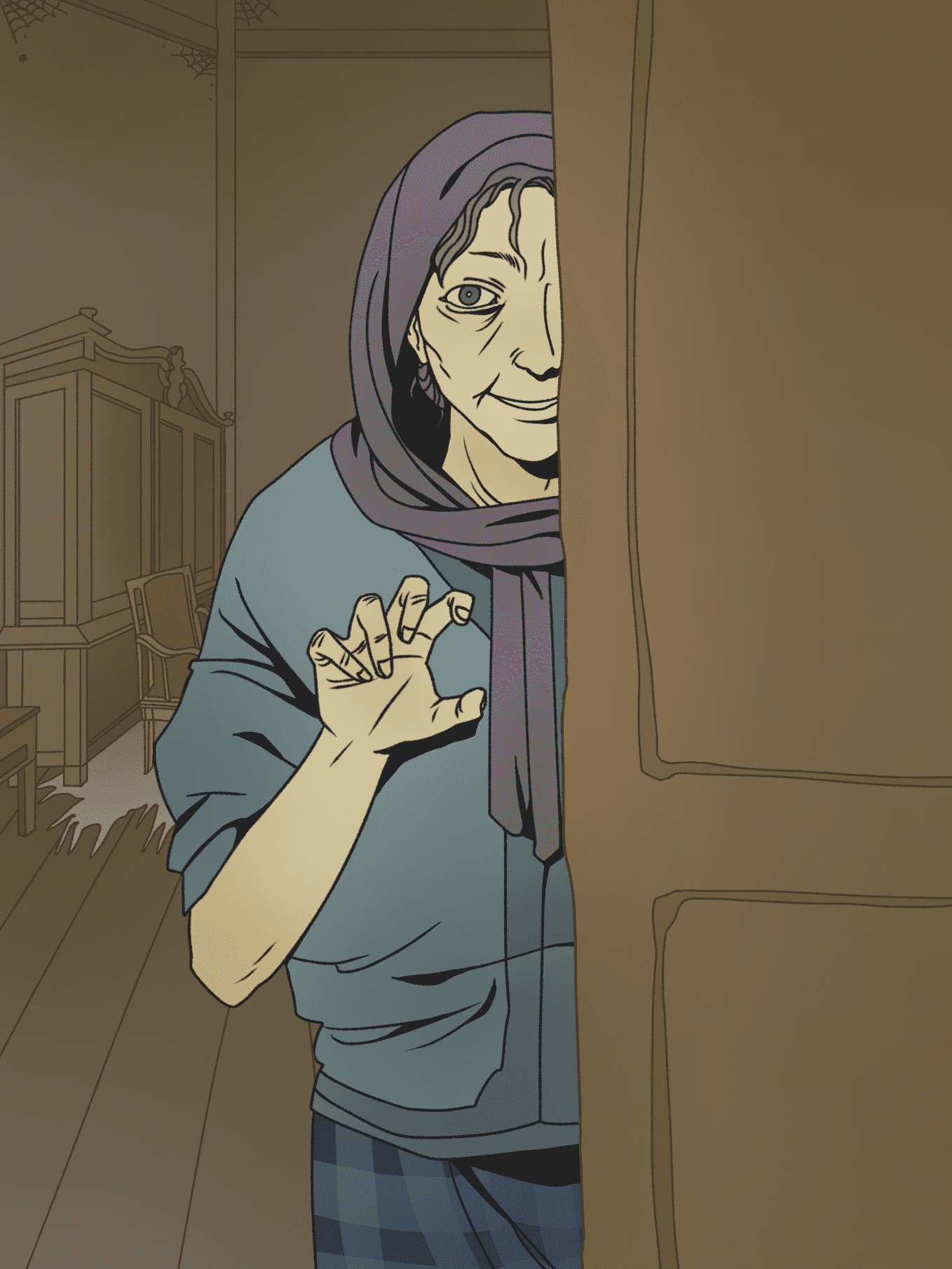
Nenek Pakande

The Brothers
South Sulawesi
NENEK PAKANDE
Be genuine when helping, don’t expect anything in return.
Moral Value
Long ago, in the kingdom of South Sulawesi, the King had 7 daughters. According to traditional beliefs, the King has to sacrifice 1 daughter to the Rajawali, a great Eagle in order for the kingdom to be spared from calamity.
Heartbroken, the king challenged the people, that any man who can defeat the Rajawali, will be married to the princess. On the day of the sacrifice, the Rajawali nearly struck the daughter before a man came and defeated the Rajawali with a rope and a dagger.
Instead of earning the promised gift, the man disappeared. Many villagers came to claim the gift, lying that they were the winners. However, the princess remembered the man’s face. The king then held a party to celebrate the safety of his daughter, hosting a Ma’raga game. Unexpectedly, the man came and played the game. The princess, who recognized him, immediately informed her father.
Faced with confrontation, the man said that he saved the princess because of the gift, but if the princess consented to the marriage, then he would accept. The princess then confessed that she fell in love at first sight. With this, their marriage took place and they lived happily ever after.

Rajawali Conqueror
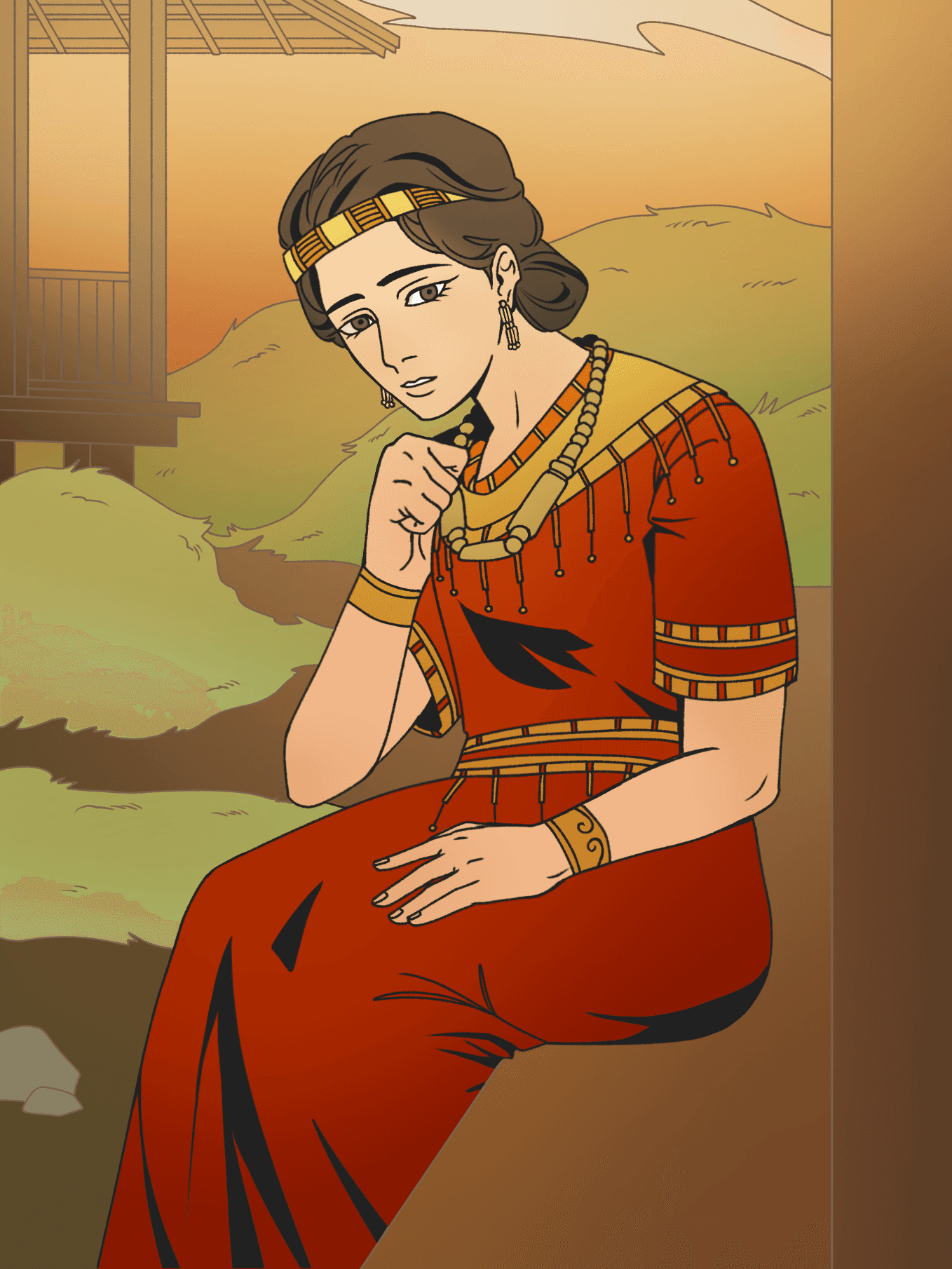
The Princess

Rajawali
South Sulawesi
Penakluk Rajawali [Eagle Conqueror]
Always stay compassionate and live with integrity.
Moral Value
La Upe, a kind and patient boy, lived under cruel treatment of his impatient stepmother after his father remarried, a situation that went unknown to his busy father. One day, he was tasked with catching a fish. After waiting for a long time, he finally caught a gigantic fish with shimmering silver scales that glinted. To his surprise, the fish spoke.
Claiming to be the King of Fish, it promised La Upe to grant his wishes, if he was let go. La Upe obeyed and he returned home empty-handed. His stepmother was ready to strike him before La Upe wished her to be stuck on the door. Immediately, a force pushed his stepmother to the door and left her stuck. She begged for forgiveness and since then, La Upe was treated kindly.
La Upe grew to become a healer. One day, the King’s daughter fell ill and no one could heal her, so he offered marriage and heirship to any man who could cure her. La Upe thought of the King of Fish’s promise and courageously went to the palace. Seeing the ill princess, he wished for the princess to be healed, and immediately, she woke up healed. The King asked how he gained the power and La Upe told him about his life and how he encountered the King of Fish. Hearing this, the King deemed him worthy to be the next heir and thus let him marry the princess. Eventually, La Upe rose to the throne and ruled with wisdom, patience, and kindness, leading the kingdom into prosperity.

King of Fish

La Upe’s Stepmother

La Upe
South Sulawesi
LA UPE
SULAWESI

Those who fail to respect their parents may one day regret it.
Moral Value
Once upon a time in West Kalimantan, there lived a mother and her daughter, Darmi. The daughter was gorgeous, but contradictingly did not have a good personality. She only cared about her appearance and never cared about her mother, who worked hard every day to make a living for both of them. Whatever Darmi wanted had to be fulfilled, even if it meant her mother had to suffer.
One day, Darmi asked for new accessories, but her mother did not know what kind of accessories she wanted, so she suggested that they go to the market together. During the journey, Darmi refused to walk beside her mother and cruelly told people that her mother was just a peasant. Hearing this, the mother’s heart broke and she silently prayed to God for justice. All of a sudden, Darmi’s body began to harden and slowly turned into stone. Even though she cried and apologized, the transformation did not stop, and she was left as a rock with tears flowing down her face. The villagers later called it the Crying Stone because it looked like it was forever crying in regret.

Darmi’s Mother
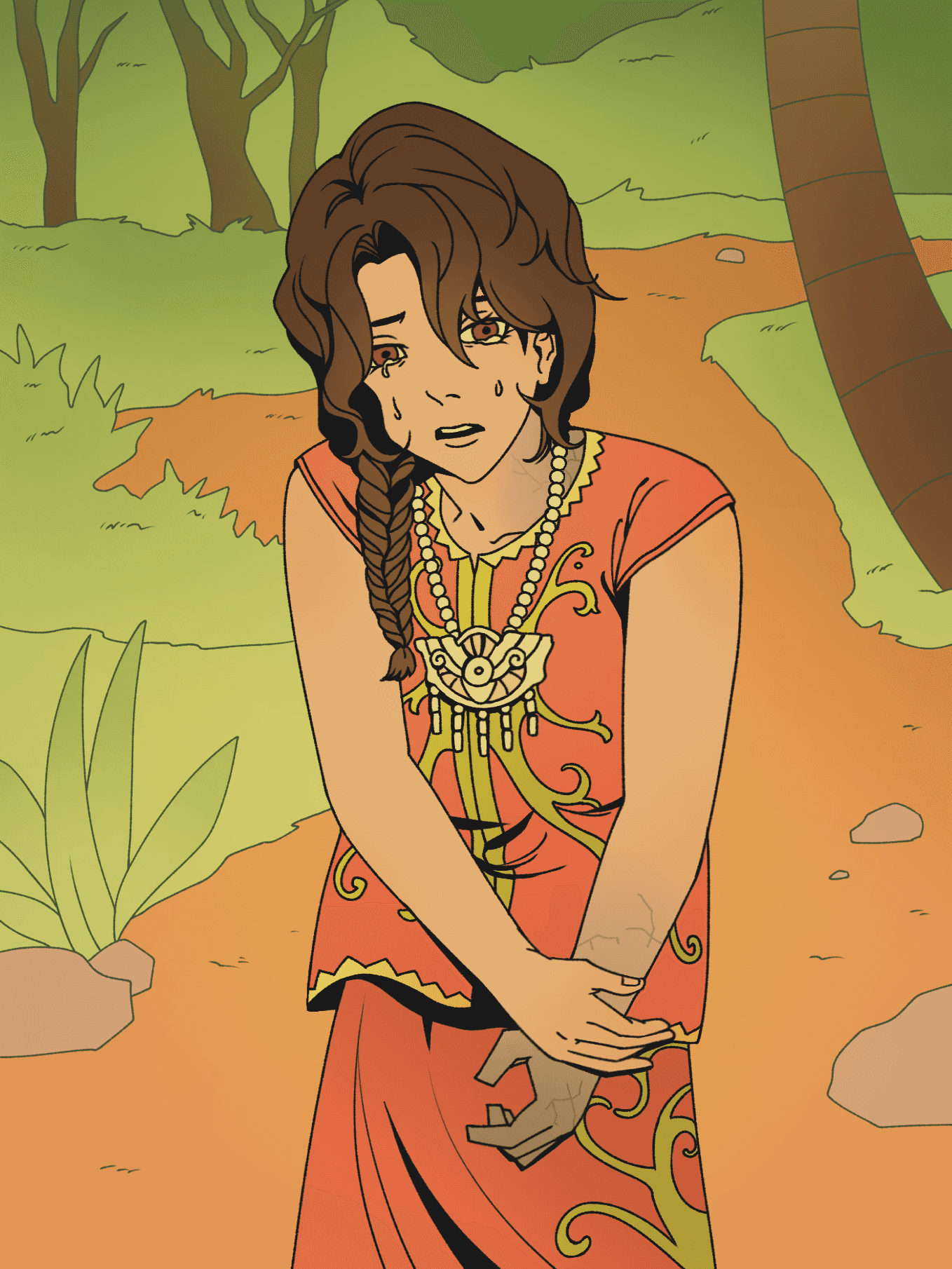
Darmi
West Kalimantan
Batu Menangis [The Crying Rock]
Always stay hopeful and believe in your dreams.
Moral Value
Once upon a time in South Kalimantan, there was a kingdom called the Kingdom of Amuntai, led by two brothers, King Patmaraga, the older brother, and King Sukmaraga, the younger brother. Neither of them had children yet, but King Sukmaraga had a strong desire to have a child. One day, King Sukmaraga received a message to meditate on an island, where he was told to give his wife a kastuba flower to eat. After following the instruction, the queen became pregnant and gave birth to beautiful twins.
Hearing this, King Patmaraga also wished to have a child and prayed to God for one. He later dreamed that he should meditate in a temple outside Amuntai. After following the dream, he returned home and saw a baby floating on a bunch of froth in the river. The baby was named Princess Junjung Buih. When the king asked his people to take the baby, they were shocked because the baby could talk. She asked for a woven cloth and blanket to be finished in half a day, and requested to be carried by forty beautiful women.
To fulfill her wishes, King Patmaraga held a competition. A woman named Queen Kuripan appeared and completed the task using her supernatural powers, becoming the caregiver of Princess Junjung Buih and helping raise her.
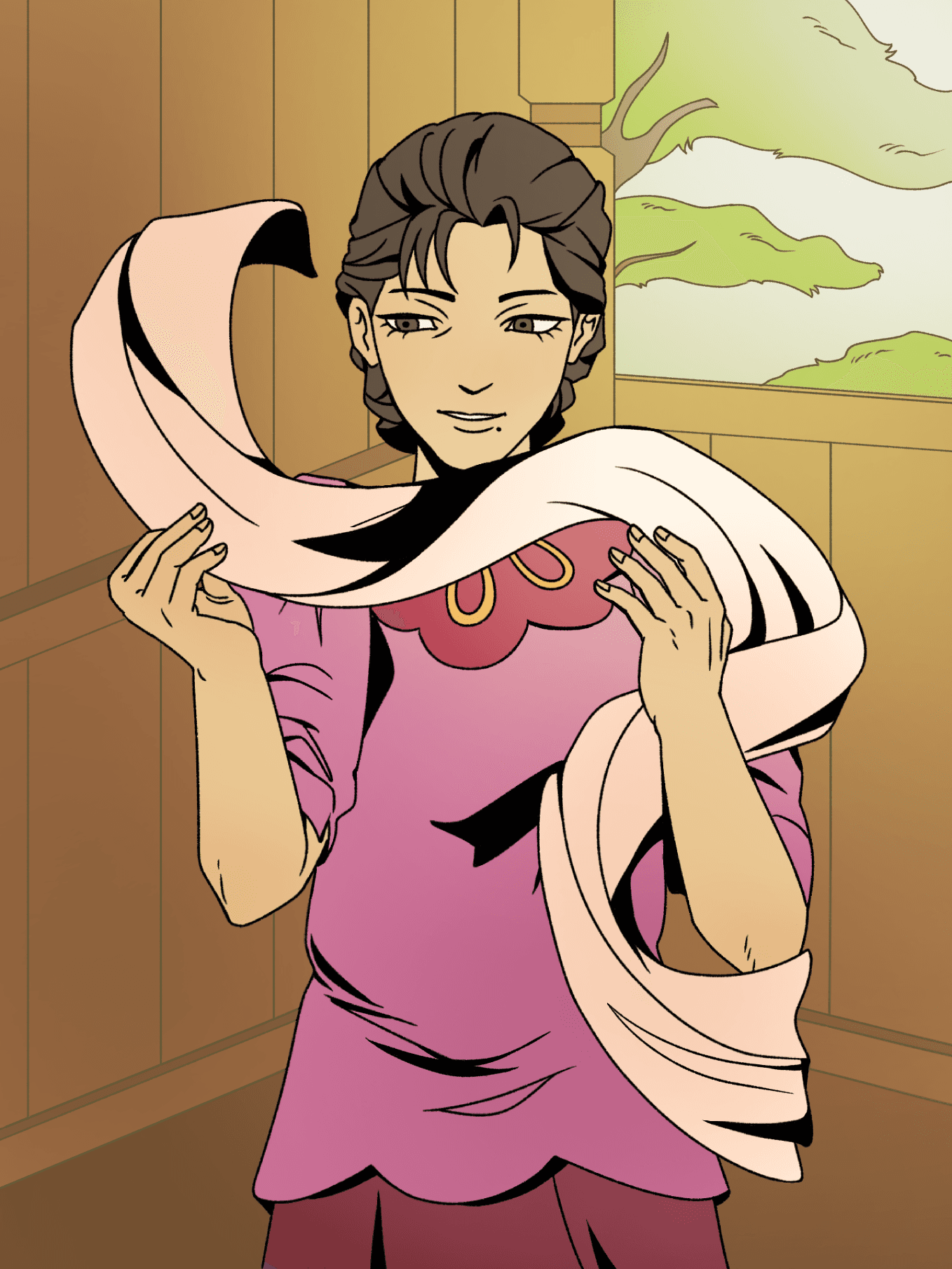
Ratu Kuripan
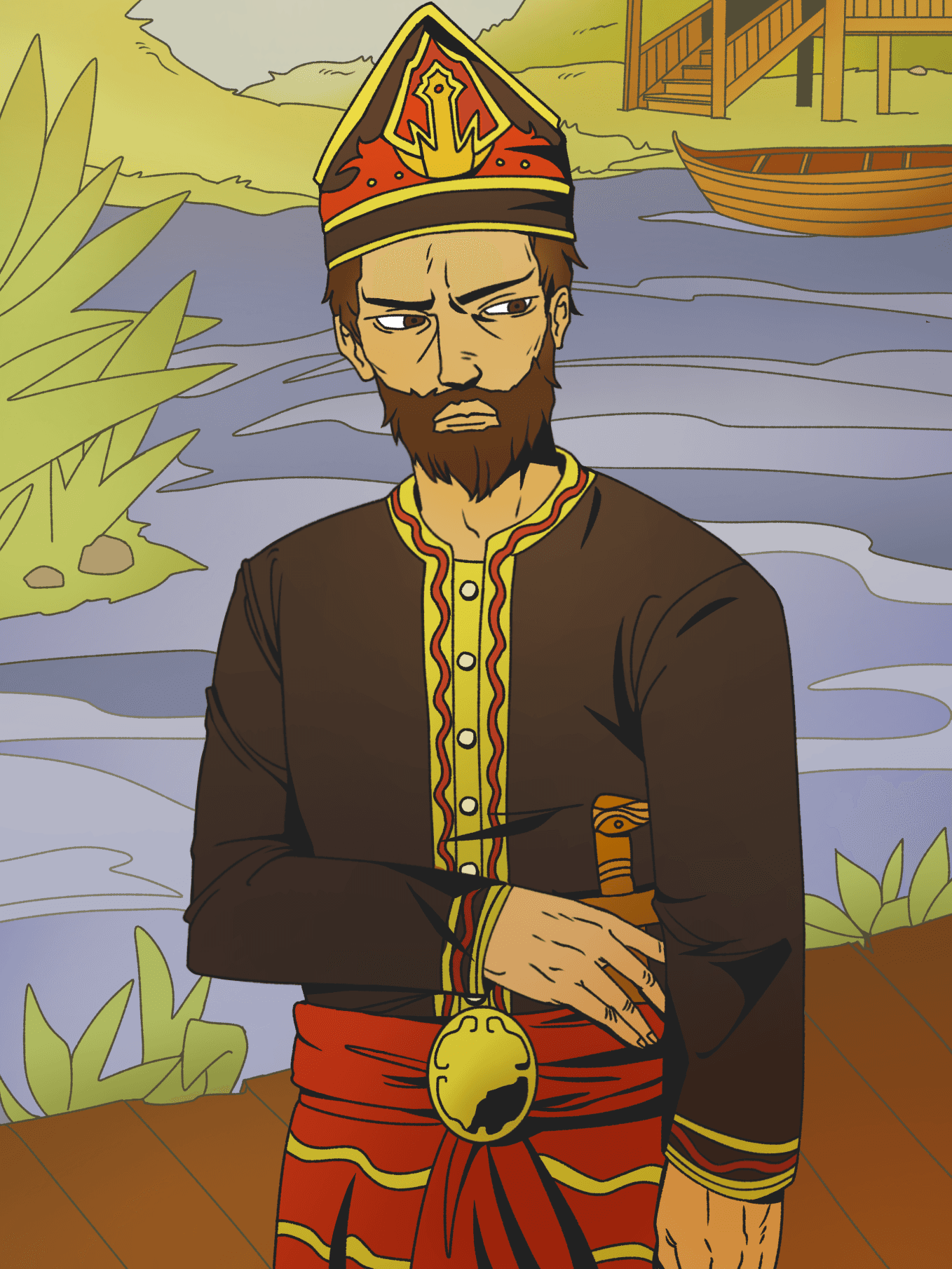
Raja Tua/Patmaraga

Princess Junjung Buih
South Kalimantan
Princess Junjung Buih
Fear can trap us, but courage and clever thinking can set us free.
Moral Value
Once upon a time in Kalimantan, there lived a princess named Laiamon, the daughter of a Dayak chief. One day, Princess Laiamon went swimming in the river when suddenly a crocodile grabbed her leg. Panicking, she begged the crocodile to release her, but it refused and said that it liked to eat humans. Princess Laiamon did not give up easily, and she remembered that her father was a respected and wealthy chief, so she tried to negotiate. She told the crocodile that her father would give it anything if she could return home safely. Hearing this, the crocodile agreed but asked to be fed a baby every day. With that agreement, Princess Laiamon was released and safely returned home.
Princess Laiamon told her father about the crocodile’s request. Her father agreed to handle it. The next day, he brought a pig to the crocodile, saying that there were no babies in the village. The crocodile accepted and ate the pig. However, soon after, the crocodile died. As it turned out, the Dayak chief had poisoned the pig, as the crocodile had eaten too many people and needed to be stopped.

The Magical Crocodile

Princess Laiamon
Kalimantan
Princess Laiamon and THE Crocodile
KALIMANTAN

Victory is not about how strong you are, but about strategy and how wisely you use what you have.
Moral Value
This story reveals the legend behind the name Minangkabau, which takes place in West Sumatra. The story began when a kingdom in West Sumatra was on the brink of being attacked by a powerful kingdom from Java Island, Majapahit. The king of West Sumatra realized that compared to Majapahit, his kingdom was much weaker in terms of power and soldiers.
Therefore, he proposed an unusual solution, that instead of going to war, they would hold a buffalo fight. Whoever’s buffalo won the battle would have the right to rule West Sumatra. Majapahit agreed to this challenge, believing they would easily win. Meanwhile, the king of West Sumatra asked the villagers to prepare a baby buffalo, separate it from its mother, and not feed it for several days.
When the day of the battle came, Majapahit brought their strongest and healthiest buffalo, while West Sumatra only brought a small baby buffalo, earning laughs from Majapahit. However, what they did not know was that the king of West Sumatra had secretly attached a sharp knife to the baby buffalo’s horns. As the battle started, the hungry baby buffalo ran toward the big buffalo, thinking it was its mother, hungrily looking for milk. The knife then stabbed the big buffalo, leading to its defeat. With this victory, West Sumatra kept their land, and the kingdom was later named Minangkabau, meaning victorious buffalo.

Baby Buffalo

King of West Sumatra
West Sumatra
MINANGKABAU
A mother’s love is unconditional, but it should never be taken for granted.
Moral Value
Many ages ago in West Sumatra, there lived Mande Rubayah, a widow, and her son, Malin Kundang. Malin was raised with so much love that it later made him grow up spoiled. As Malin grew older, his curiosity about the world grew stronger, so he asked for his mother’s blessing to seek opportunities in big cities. With a heavy heart, Mande Rubayah let her son leave home, and every day she prayed that Malin would return safely.
Years later, Mande heard news that her son had married a noble woman. One day, a luxurious ship docked in their village, and a well-dressed couple stepped down from it. Mande immediately recognized the man as Malin Kundang, so she ran toward him and hugged him, crying because she was finally reunited with her son. However, Malin’s wife looked upset and asked if the woman was really his mother, since Malin had lied that his mother was also a noblewoman. Hearing this, Malin denied knowing Mande and pushed her away, leaving her alone.
Heartbroken, Mande prayed to God that if Malin was truly her son, then she would ask for justice. Soon after, a violent storm struck Malin’s ship and destroyed it. After the storm, a rock shaped like a kneeling man appeared on the shore, believed to be Malin Kundang turned into stone while begging for forgiveness.
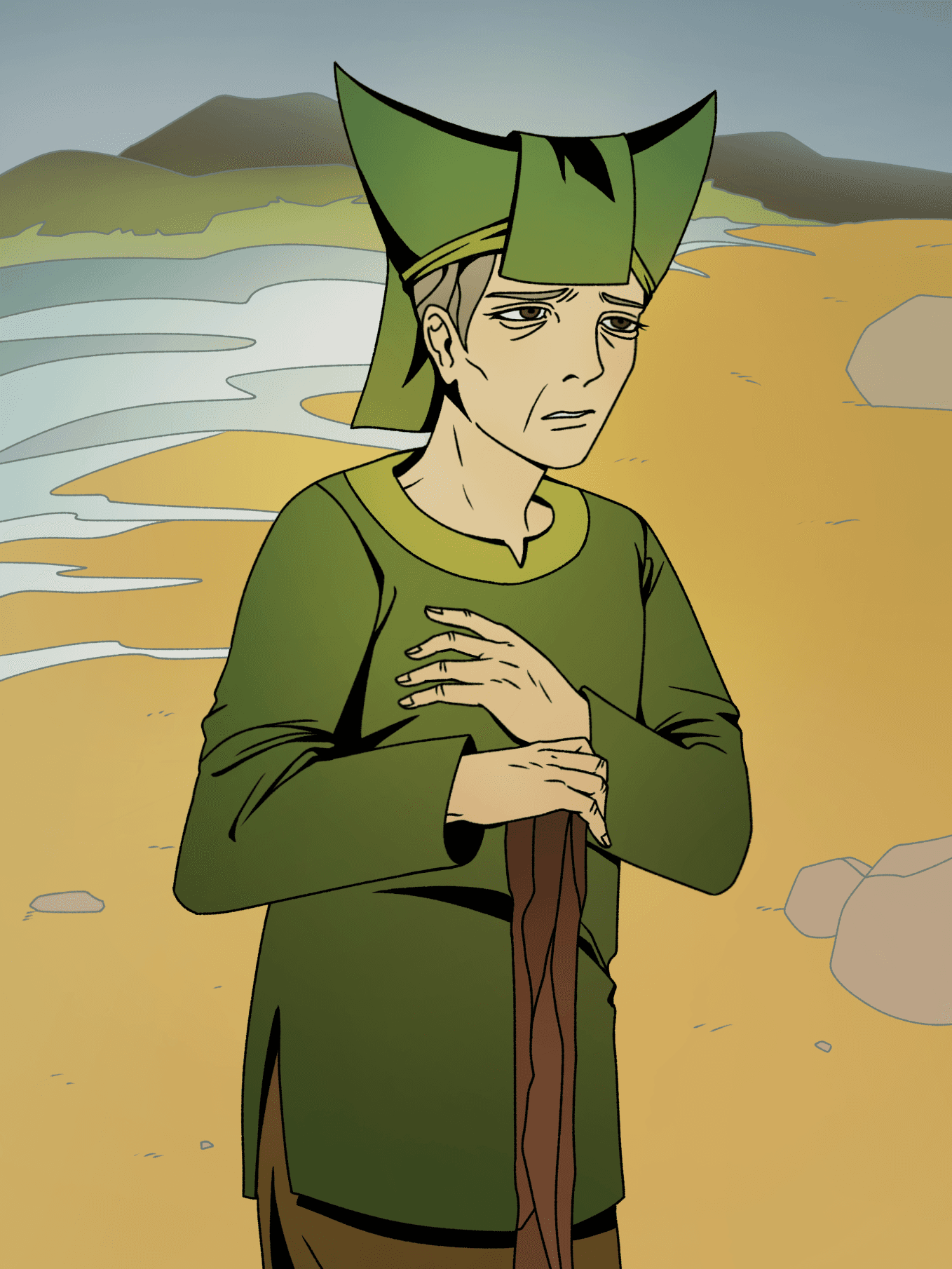
Mande Rubayah

Malin Kundang
West Sumatra
MALIN KUNDANG
Let your wisdom be stronger than your anger.
Moral Value
A long time ago, there was a farmer named Toba who caught a talking fish, pleading for its release. Surprised, Toba set it free, and the fish instantly transformed into a beautiful princess. She explained she had been cursed and could only break the spell through marriage. Toba agreed to marry her, but she set one strict condition: he must never reveal that she was once a fish.
Eventually, they had a son named Samosir. One day, Samosir was asked to deliver a lunchbox to his father in the fields. However, being hungry, Samosir ate the food along the way. When he arrived with an empty box, Toba flew into a rage and accidentally shouted that Samosir was the "son of a fish."
Deeply hurt, Samosir ran home to his mother. Realizing the secret was broken, the princess told her son to run to high ground. Suddenly, the sky turned grey and a massive rainstorm flooded the land. The princess turned back into a fish, and the entire village was submerged, forming Lake Toba.

Toba’s Wife
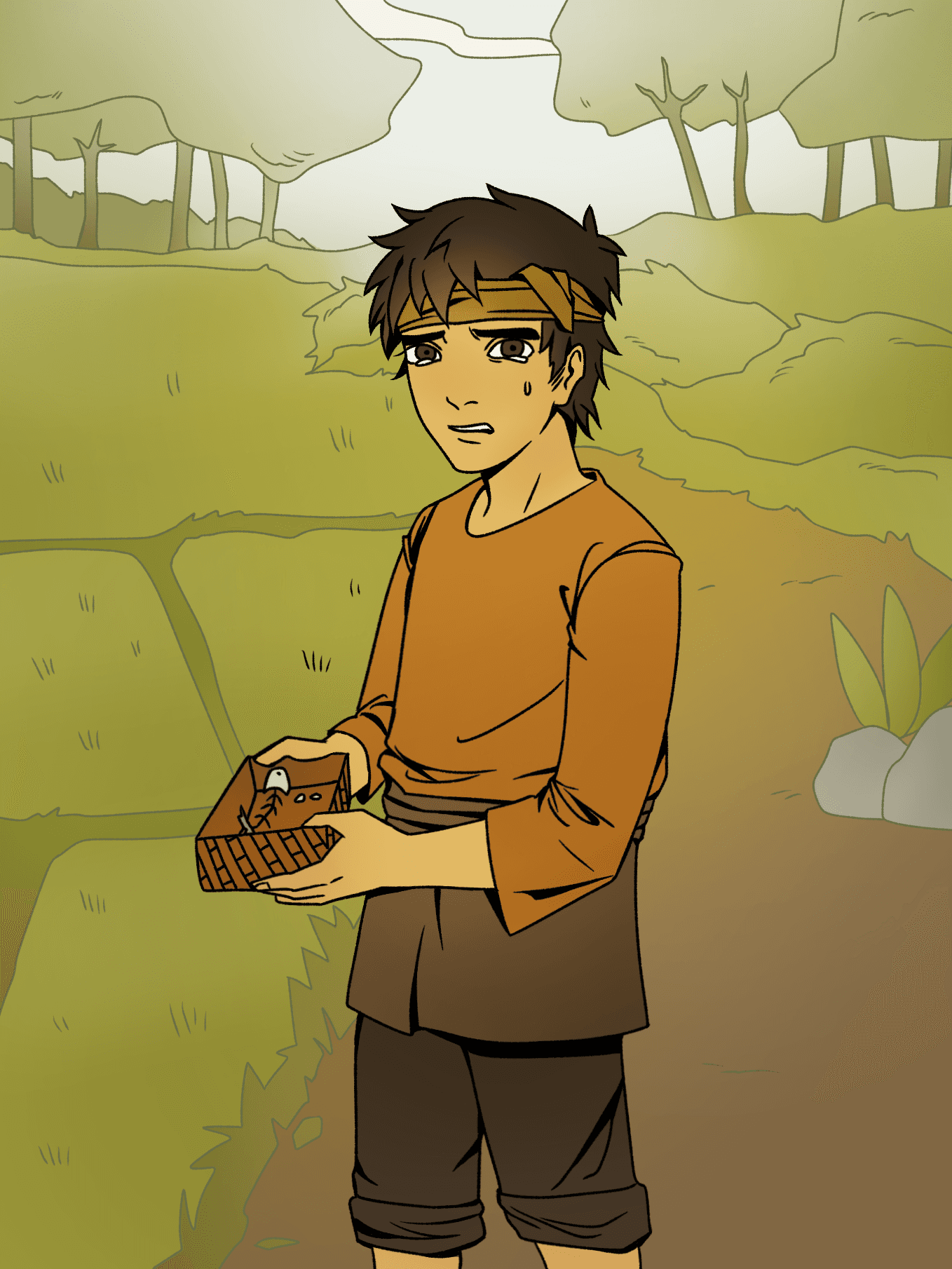
Samosir

Toba
North Sumatra
DANAU TOBA
SUMATRA

Hate will destroy family bonds, but forgiveness will heal the hurting heart.
Moral Value
In the Kingdom of West Java, King Prabu Tapa Agung decided to pass his kingdom down to his youngest daughter, Purbasari. This decision angered Purbararang, the eldest daughter, as she felt it was unfair. To stop her sister, she asked a witch to put a spell on Purbasari, covering her body in black dots. Purbasari was then secluded from her village and forced to stay in the jungle.
In the jungle, she spent her time with animals, being especially close to a talking monkey named Lutung Kasarung, who was actually a disguised god. He helped Purbasari by creating a small lake to bathe in, curing her disease.
Purbasari then returned to the kingdom to fulfill her father’s decision. However, Purbararang found new reasons to stop her. First, they measured their hair, and Purbasari’s was longer. Then, Purbararang challenged her to see who had the most handsome fiancé. She flaunted her fiancé, Indrajaya, and mocked Purbasari for having a monkey. Suddenly, to everyone’s surprise, Lutung Kasarung transformed into his human form of a handsome man. Purbasari finally became Queen, and kindly forgave her sister, letting her stay in the kingdom.

Purbararang

Purbasari

Lutung Kasarung
West Java
Lutung Kasarung
Even when a promise brings danger, bravery will always triumph over evil.
Moral Value
The story of Timun Mas began with a widow who longed for a child that she could not have. Until one day, a giant named Buto Ijo offered her golden cucumber seeds so she could finally have what she wanted, a child. However, nothing comes for free. The giant would only give her the seeds if she agreed to give the child to him as food when the child grew up. Blinded by her desire, the widow accepted the offer without hesitation.
After planting the seeds, a giant cucumber grew and a beautiful baby girl was born. The widow named her Timun Mas. Timun Mas grew to become a brave and kind girl, making the widow more worried about her future. Thus, she visited a monk for help. The monk gave her four magical items that could help Timun Mas escape her destiny.
When the time came, Buto Ijo returned to claim the widow’s promise, but the widow told Timun Mas to run, giving her the magical items to protect herself.
As Buto Ijo chased Timun Mas, she threw the cucumber seeds which grew into thorny vines, trapping the giant, yet he managed to escape. Then, she threw a needle that turned into a sharp bamboo forest, slowing him down, followed by salt that turned the ground into a sea, but the giant still crossed it. Finally, she threw a shrimp paste which turned the ground into a swamp and drowned the exhausted giant, allowing Timun Mas to return home and reunite with her mother.

Buto Ijo
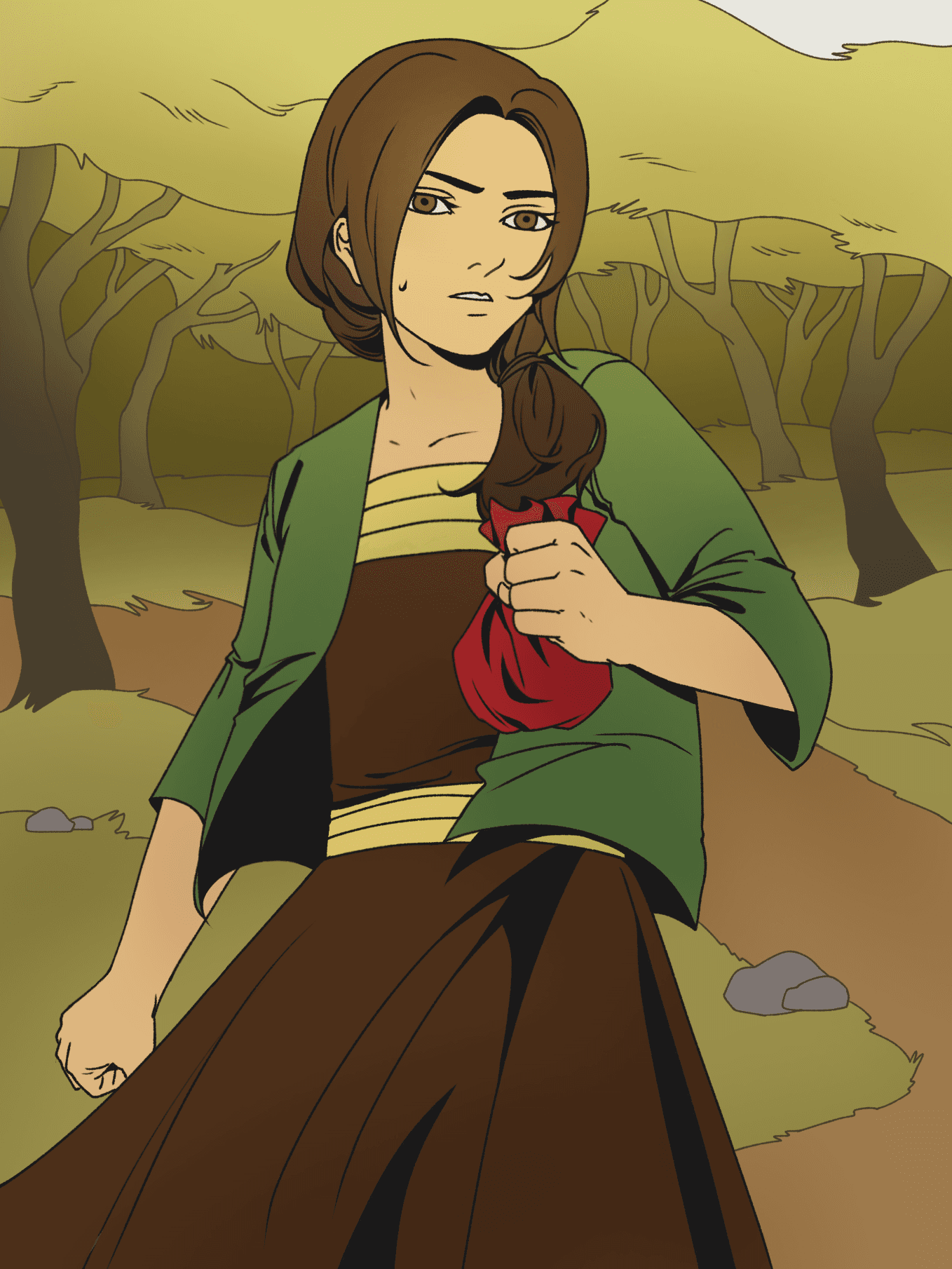
Timun Mas
Central Java
TIMUN MAS
Be faithful and believe that there will be ease after hardship.
Moral Value
Prince Panji Asmarabangun from the Jenggala Kingdom married Princess Sekartaji of Kediri with the intention to prevent conflict between the two kingdoms. However, one day, the Jenggala Kingdom was attacked. When the war broke out, Sekartaji fled to a distant village and disguised herself as Klenting Kuning, a peasant serving a wealthy widow and her three daughters.
After the war was over, Prince Panji searched for Princess Sekartaji, disguising himself as Ande-Ande Lumut, a man seeking a bride. The widow’s daughters, named Klenting Merah, Klenting Biru, and Klenting Hijau, competed for his attention, while Klenting Kuning stayed loyal to her marriage and preferred to stay at home. Klenting Kuning was busy doing chores, when a stork revealed to Klenting Kuning that Ande-Ande Lumut was her husband and gave her a protective whip. To get to Ande-Ande Lumut, they must cross a river, where a giant crab, Yuyu Kangkang, requested a kiss in exchange for them to pass the river. The three sisters kissed Yuyu Kangkang, but Klenting Kuning used the whip to scare it away.
When all of them arrived at Ande-Ande Lumut’s place, he rejected the sisters because he knew that the three sisters already kissed Yuyu Kangkang and eventually chose Klenting Kuning, revealing himself as Prince Panji and recognized his own wife.

Yuyu Kangkang
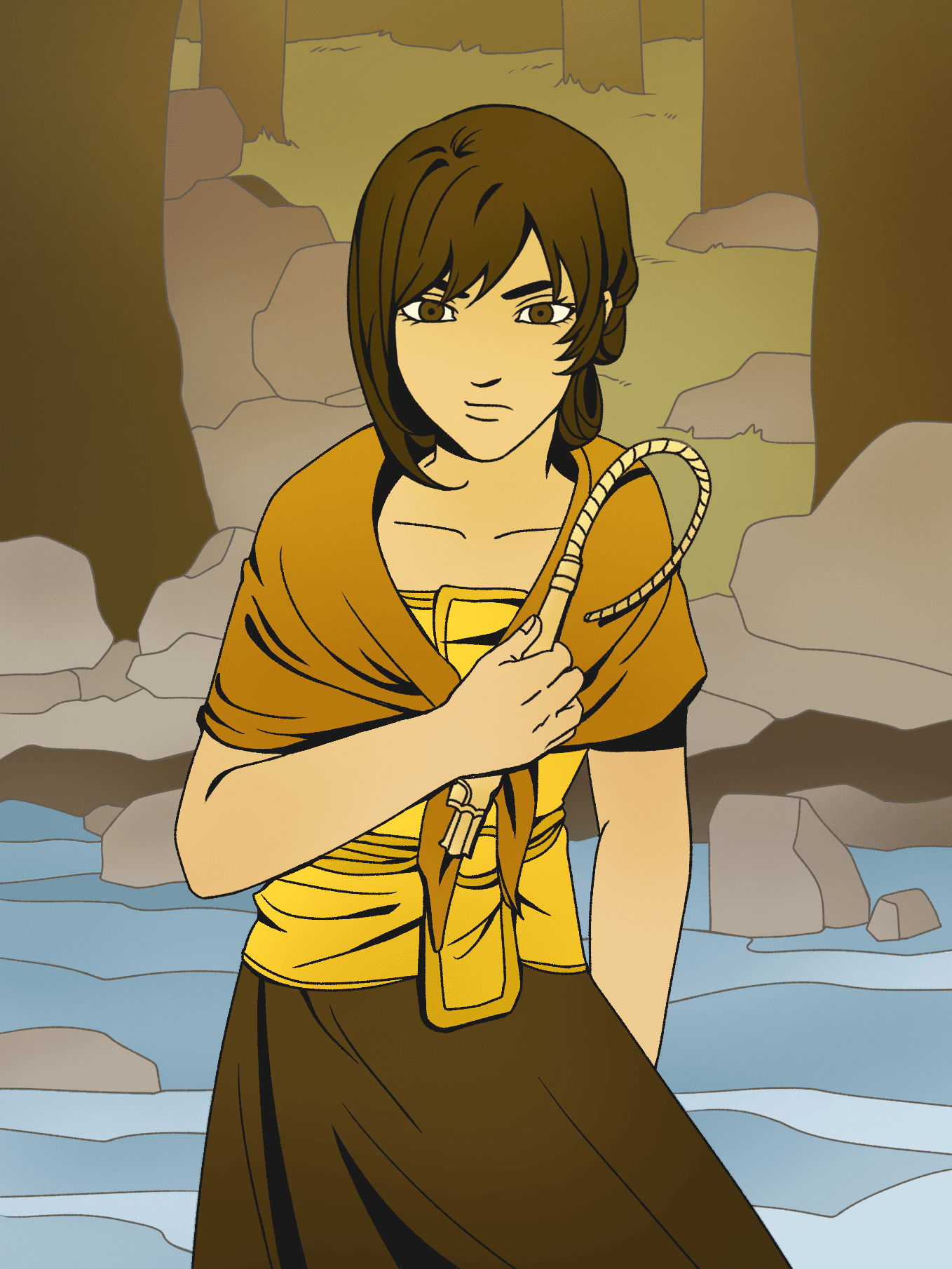
Klenting Kuning
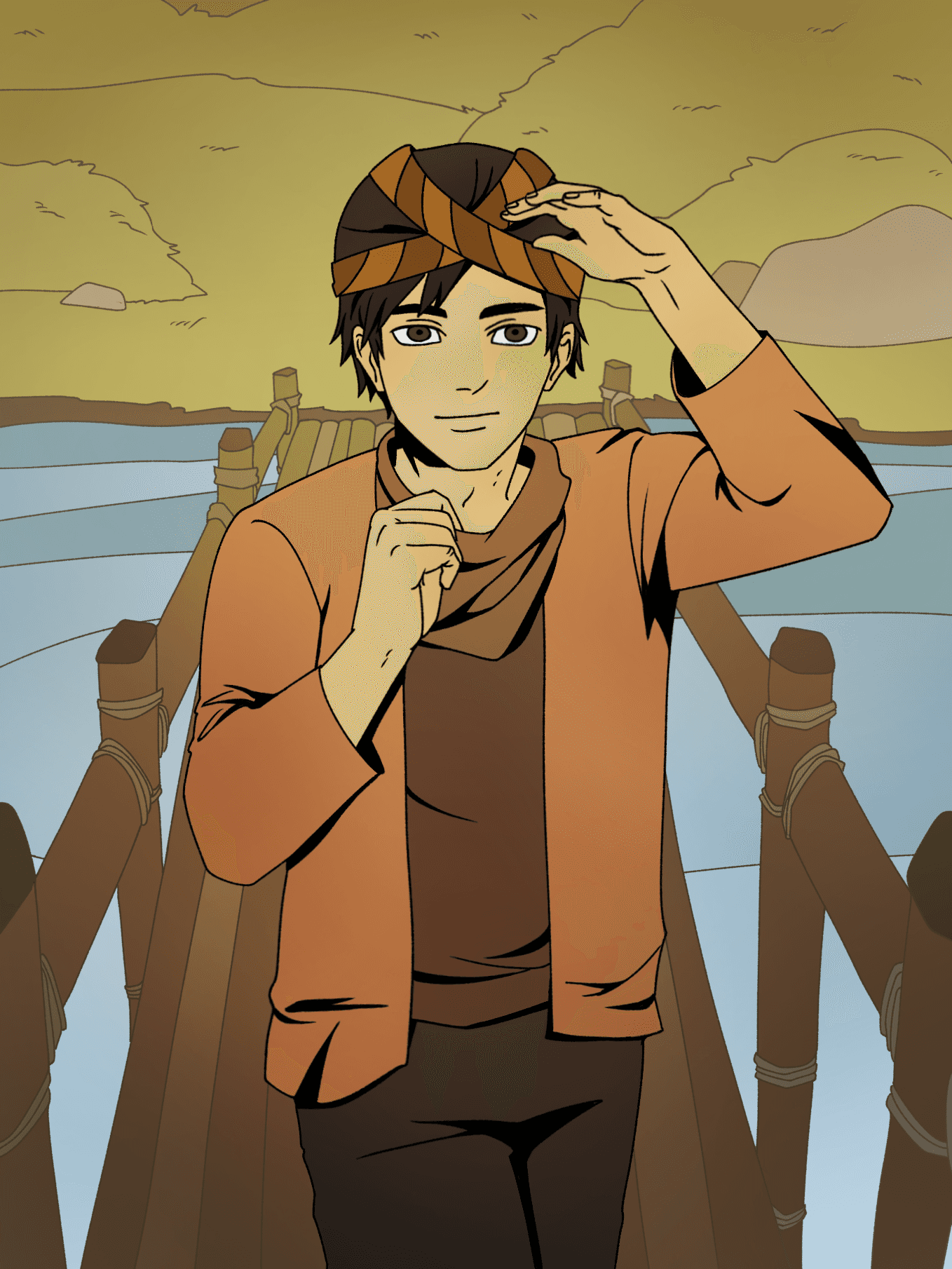
Klenting Kuning
Prince Panji
East Java
ANDE-ANDE LUMUT
JAVA






PAPUA
SULAWESI
KALIMANTAN
SUMATRA
JAVA

Cultural Inspiration
The gameplay introduces players to various folklore characters. Each card contains visual illustrations and short descriptions that help players understand the characters while incorporating them into the story.
Storytelling Gameplay
Indonesia, which is culturally diverse, has an abundance of folklore characters and stories that are not fully tapped-in yet on modern-day visual communication.
Cultural Values
Folklores are a constant part of our childhood with life lessons tucked into each story, relevant to its origins, playing a crucial role in preserving traditions and shaping identities and values.
Indonesian Folklore

"Cerita Rakyat" is an Indonesian term that translates to "folktale" or "folk story" in English. These tales are deeply rooted in Indonesian culture and serve to preserve history, values, and traditions. This is why we take on the name for our interactive story telling game. It is designed to introduce and preserve Indonesian folklore through enjoyable gameplay.
What is Cerita Rakyat?
Through thoughtfully designed character cards, narrative cards, and illustrative elements, the game conveys the personality, roles, and background of each folklore figure.
Visually Communicate Folklore
Storytelling mechanics encourage players to be creative, quick-witted, and collaborative.
Entertaining Gameplay Experience
By incorporating these tales into a card game format, we actively preserve cultural knowledge and make it accessible for younger generations.
Preserve Indonesian Culture
Our Objectives
We have noticed that many Indonesian folktales are slowly fading from public memory, especially among younger generations who are more exposed to modern digital entertainment than traditional storytelling. These stories, once passed down orally from parents to children and shared within communities, carry deep cultural values, moral lessons, and historical identity. However, without active preservation and reinterpretation, they risk being forgotten over time.
By approaching folklore through a card game format, we aim to reintroduce these narratives in a way that feels engaging, and relevant to today’s audience. A storytelling card game raises curiosity to understand folklores through a fun and enjoyable process. Moreover, it helps the public recognize the important cultural narratives in visual media that are based on folklore.
Background

We are a group of graphic designers who believe that stories shape identity. Inspired by the richness of Indonesian folklore, we created Cerita Rakyat as a way to preserve and reinterpret these tales through visual storytelling.
About Us
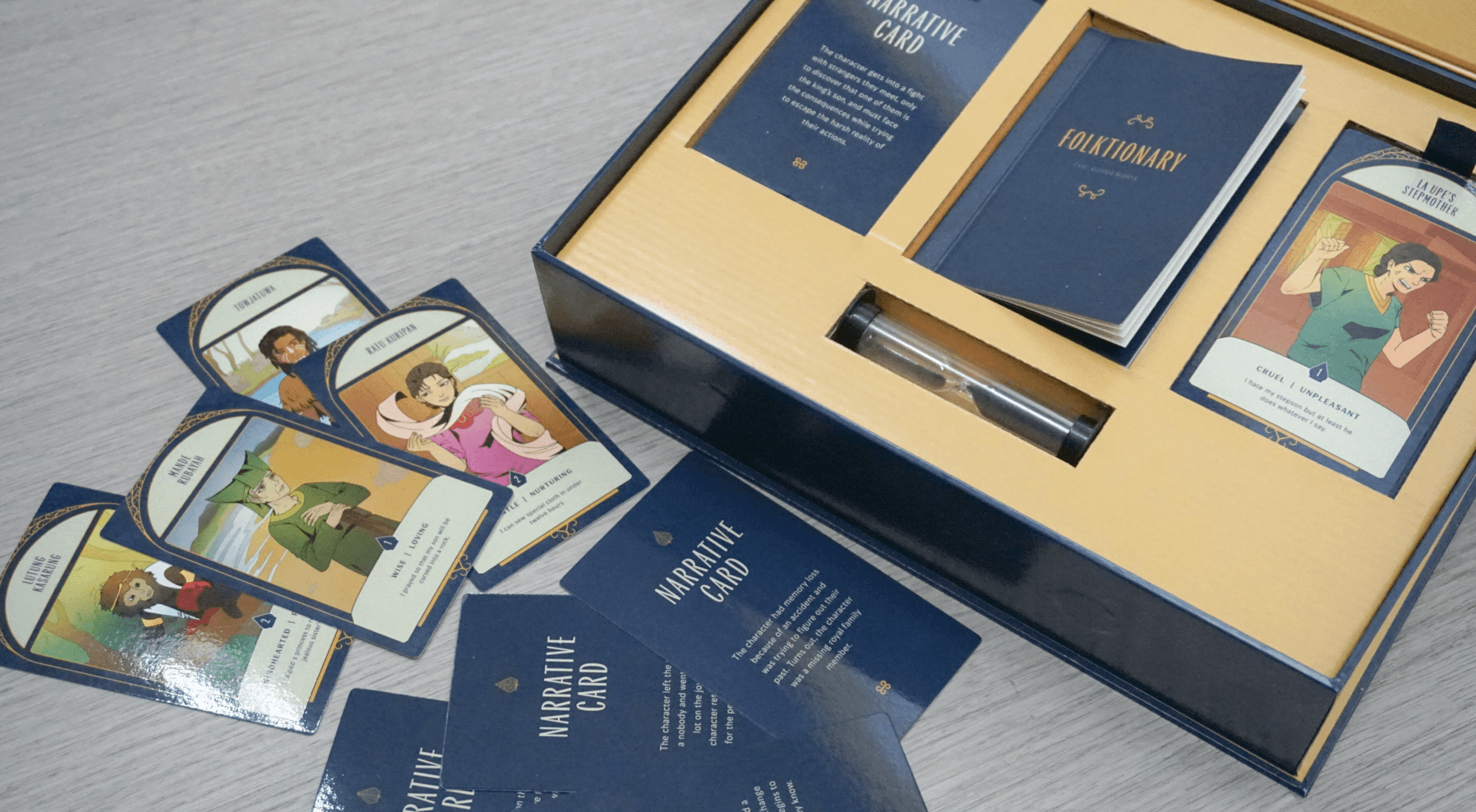
Reviving Indonesian folklore through storytelling card game.
Cerita Rakyat:
Tales of the Olden

© 2026 Cerita Rakyat: Tales of the Olden. All rights reserved.
A storytelling card project inspired by Indonesian folklore traditions.
An interactive storytelling card game inspired by traditional Indonesian folklores. Immerse yourself in engaging gameplay.
Cerita Rakyat: Tales of the Olden
The amount of times a character card must be used before it is considered discarded from a player’s deck.
Activation Numbers
Serves as the guidebook for players to understand each character’s background and role in their folklore.
Folktionary
With a total of twenty narrative cards, these cards provide each round of the game with a beginning and an ending.
Narrative Cards
There are a total of forty character cards. Each card holds information of the character’s name, personality, description, and activation number.
Character Cards
Game Components
The first player to discard all of their Character Cards is declared the winner. The last player standing must then create the final ending of the story and conclude it based on the narrative for all players. This makes the last player as the story closer, even though they lost.
Winning Condition
Cerita Rakyat is a storytelling card game based on Indonesian folklore where players must create their own stories based on a narrative card using different folklore characters. Match the plot with the narrative, make sure to be quick-witted when making up stories, and ensure the characters do not stray from their personality.
Player count: 5-8 players.
Introduction
Gameplay
Always persist and be diligent in your responsibilities.
Moral Value
On the bank of Tami River, in Papua, a man named Towjatuwa stood anxiously for his pregnant old wife. The only way to deliver the baby safely is by operating on her using a sharp stone from the river. When searching for the stone, Towjatuwa started hearing sounds behind him. When he looked back, he was startled to see an enormous crocodile, slowly stalking towards him. Towjatuwa was terrified because the crocodile looked unnatural with its back growing with the fur of the Cassowary bird.
But when Towjatuwa was about to flee, the crocodile spoke kindly and introduced itself as Watuwe, asking Towjatuwa what he was searching for in the river. Towjatuwa told his worries about his wife. Watuwe, who was generous, told him not to worry and that he would visit their house at night to help Towjatuwa’s wife give birth.
Happily, Towjatuwa returned home and told the magical encounter to his wife. True to Watuwe’s words, that same night, Watuwe came to help them. They gave birth to a baby boy named Narrowra. Watuwe predicted that Narrowra would become a skilled hunter. This help came with a condition that they must not consume crocodile’s meat or else, their descendants will die. Towjatuwa and his family kept this promise, looking after the animals that lived near the Tami River from hunters.
Watuwe
Towjatuma
South Sulawesi
Watuwe si Buaya Ajaib [Watuwe the Magical Crocodile]
Be faithful and loyal in your responsibilities.
Moral Value
The story of Ampat Raja tells of the origins of the Raja Ampat region in Papua. It began with a couple longing for a child who, during a rainy season, while gathering firewood, discovers six large eggs by the Waikeo river. Five of the eggs hatched and produced four boys—War, Betani, Dohar, and Mohamad—and one girl, Pintolee, while one egg turned to stone. Grateful for the blessing, the couple raised their children diligently.
However, Pintolee chose to marry against her family's wishes and sailed away on a giant clam shell, stranded on Numfor Island. Despite her absence, her brothers supported their parents and later inherited islands from their father: War received Waigeo Island, Betani got Salawati Island, Dohar was given Lilinta Island, and Mohamad received Waiga Island.
The brothers successfully cultivated their respective islands into prosperous realms. The stone from the unhatched egg, named Kapatnai, is revered as a king by the local people, safeguarded in a special room alongside two menhir stones, Man Moro and Man Metem, at the Kali Raja Historical Site in Raja Ampat. The stone's sanctity allows public view only once a year during specific ceremonies conducted by the royal lineage.
Pintolee
Dohar
Betani
War
Mohamad
Raja Ampat
AMPAT RAJA
With bravery and perseverance, troubles can be overcome.
Moral Value
In a prosperous village in Mimika, the people relied on sago to live. One day, as the sago supply started dwindling, they traveled to the forest, crossing a large river to search for more sago. During the journey, they encountered an enormous dragon who killed everyone except one pregnant woman, who fled and survived in the forest. Eventually, she gave birth to a son named Biwar.
One day, Biwar asked his mother for permission to hunt in the forest. His mother agreed, but did not allow him to go near the big river. Curious, Biwar disobeyed and found that the fishes were much larger, so he fished there. His mother realized the fishes were larger than their usual ones and confronted him, prompting Biwar to confess that he fished in the big river. Biwar’s mother then explained the devastating story of how the dragon killed the villagers, including Biwar’s father. Filled with anger, he kept on pushing his mother to let him kill the dragon.
Though at first his mother disagreed, Biwar was adamant and so she agreed to his request. Biwar left with an arrow and a spear, leaving his mother worried. In the river, he challenged the dragon and started attacking it but the dragon was not at all affected by Biwar’s weapons. Thinking quickly, Biwar ran to the cliff and when the dragon was about to blast a huge fire from its mouth, Biwar pushed a giant rock to its head. The rock hit its head and killed the dragon at once. With the defeat of the dragon, they decided to return to their village. They told the stories of how they survived and how Biwar conquered the dragon.
The Dragon
Biwar
Mimika
BIWAR SANG PENAKLUK NAGA [BIWAR THE DRAGON CONQUEROR]
PAPUA
There is always a way out when thinking clearly and wisely.
Moral Value
Rumors about Nenek Pakande were already heard as she is known for having magical power using witchcraft, but to preserve her power, she needs to constantly consume children. She traveled across villages to prey on children and at last, she arrived at the Soppeng regency.
One afternoon, as the sun was setting, two brothers were still playing outside and didn’t listen to their mother who told them to go inside before it was dark. Nenek Pakande, who was secretly spying, quickly kidnapped them. When the mother came back outside, she was stunned to find her children missing. Her hysterical shouts drew the neighbors’ attention, who helped her find the boys, albeit unsuccessfully.
The village was gathered to find the boys when another woman came crying, saying that her baby had gone missing. Suddenly, a young man, La Beddu, appeared, saying that Nenek Pakande is the culprit. He proposed a bold, risky idea to stop Nenek Pakande involving her one fear; a good giant who ate cruel humans, King Bangkung Pitu, who has not been seen in a long time.
With La Beddu’s instructions, they lured Nenek Pakande to a lone house with bright lights and the cries of a baby. They used turtles and pitchforks to cast the shadow of the giant while imitating its voice using dried bamboo shoot skin and soapy water as his spit, warning Nenek Pakande to stay away from the baby. Upon seeing the shadow, she was terrified and tried to run. She stumbled backwards and slipped on the eels, hitting her head on the large stones that were placed by the villagers after she entered the house. The body was then cremated and the two boys returned safely, having been fed by Nenek Pakande, who wanted them to be more palatable.
La Beddu
Nenek Pakande
The Brothers
South Sulawesi
NENEK PAKANDE
Be genuine when helping, don’t expect anything in return.
Moral Value
Long ago, in the kingdom of South Sulawesi, the King had 7 daughters. According to traditional beliefs, the King has to sacrifice 1 daughter to the Rajawali, a great Eagle in order for the kingdom to be spared from calamity.
Heartbroken, the king challenged the people, that any man who can defeat the Rajawali, will be married to the princess. On the day of the sacrifice, the Rajawali nearly struck the daughter before a man came and defeated the Rajawali with a rope and a dagger.
Instead of earning the promised gift, the man disappeared. Many villagers came to claim the gift, lying that they were the winners. However, the princess remembered the man’s face. The king then held a party to celebrate the safety of his daughter, hosting a Ma’raga game. Unexpectedly, the man came and played the game. The princess, who recognized him, immediately informed her father.
Faced with confrontation, the man said that he saved the princess because of the gift, but if the princess consented to the marriage, then he would accept. The princess then confessed that she fell in love at first sight. With this, their marriage took place and they lived happily ever after.
Rajawali Conqueror
The Princess
Rajawali
South Sulawesi
Penakluk Rajawali [Eagle Conqueror]
Always stay compassionate and live with integrity.
Moral Value
La Upe, a kind and patient boy, lived under cruel treatment of his impatient stepmother after his father remarried, a situation that went unknown to his busy father. One day, he was tasked with catching a fish. After waiting for a long time, he finally caught a gigantic fish with shimmering silver scales that glinted. To his surprise, the fish spoke.
Claiming to be the King of Fish, it promised La Upe to grant his wishes, if he was let go. La Upe obeyed and he returned home empty-handed. His stepmother was ready to strike him before La Upe wished her to be stuck on the door. Immediately, a force pushed his stepmother to the door and left her stuck. She begged for forgiveness and since then, La Upe was treated kindly.
La Upe grew to become a healer. One day, the King’s daughter fell ill and no one could heal her, so he offered marriage and heirship to any man who could cure her. La Upe thought of the King of Fish’s promise and courageously went to the palace. Seeing the ill princess, he wished for the princess to be healed, and immediately, she woke up healed. The King asked how he gained the power and La Upe told him about his life and how he encountered the King of Fish. Hearing this, the King deemed him worthy to be the next heir and thus let him marry the princess. Eventually, La Upe rose to the throne and ruled with wisdom, patience, and kindness, leading the kingdom into prosperity.
King of Fish
La Upe’s Stepmother
La Upe
South Sulawesi
LA UPE
SULAWESI
Those who fail to respect their parents may one day regret it.
Moral Value
Once upon a time in West Kalimantan, there lived a mother and her daughter, Darmi. The daughter was gorgeous, but contradictingly did not have a good personality. She only cared about her appearance and never cared about her mother, who worked hard every day to make a living for both of them. Whatever Darmi wanted had to be fulfilled, even if it meant her mother had to suffer.
One day, Darmi asked for new accessories, but her mother did not know what kind of accessories she wanted, so she suggested that they go to the market together. During the journey, Darmi refused to walk beside her mother and cruelly told people that her mother was just a peasant. Hearing this, the mother’s heart broke and she silently prayed to God for justice. All of a sudden, Darmi’s body began to harden and slowly turned into stone. Even though she cried and apologized, the transformation did not stop, and she was left as a rock with tears flowing down her face. The villagers later called it the Crying Stone because it looked like it was forever crying in regret.
Darmi’s Mother
Darmi
West Kalimantan
Batu Menangis [The Crying Rock]
Always stay hopeful and believe in your dreams.
Moral Value
Once upon a time in South Kalimantan, there was a kingdom called the Kingdom of Amuntai, led by two brothers, King Patmaraga, the older brother, and King Sukmaraga, the younger brother. Neither of them had children yet, but King Sukmaraga had a strong desire to have a child. One day, King Sukmaraga received a message to meditate on an island, where he was told to give his wife a kastuba flower to eat. After following the instruction, the queen became pregnant and gave birth to beautiful twins.
Hearing this, King Patmaraga also wished to have a child and prayed to God for one. He later dreamed that he should meditate in a temple outside Amuntai. After following the dream, he returned home and saw a baby floating on a bunch of froth in the river. The baby was named Princess Junjung Buih. When the king asked his people to take the baby, they were shocked because the baby could talk. She asked for a woven cloth and blanket to be finished in half a day, and requested to be carried by forty beautiful women.
To fulfill her wishes, King Patmaraga held a competition. A woman named Queen Kuripan appeared and completed the task using her supernatural powers, becoming the caregiver of Princess Junjung Buih and helping raise her.
Ratu Kuripan
Raja Tua/Patmaraga
Princess Junjung Buih
South Kalimantan
Princess Junjung Buih
Fear can trap us, but courage and clever thinking can set us free.
Moral Value
Once upon a time in Kalimantan, there lived a princess named Laiamon, the daughter of a Dayak chief. One day, Princess Laiamon went swimming in the river when suddenly a crocodile grabbed her leg. Panicking, she begged the crocodile to release her, but it refused and said that it liked to eat humans. Princess Laiamon did not give up easily, and she remembered that her father was a respected and wealthy chief, so she tried to negotiate. She told the crocodile that her father would give it anything if she could return home safely. Hearing this, the crocodile agreed but asked to be fed a baby every day. With that agreement, Princess Laiamon was released and safely returned home.
Princess Laiamon told her father about the crocodile’s request. Her father agreed to handle it. The next day, he brought a pig to the crocodile, saying that there were no babies in the village. The crocodile accepted and ate the pig. However, soon after, the crocodile died. As it turned out, the Dayak chief had poisoned the pig, as the crocodile had eaten too many people and needed to be stopped.
The Magical Crocodile
Princess Laiamon
Kalimantan
Princess Laiamon and THE Crocodile
KALIMANTAN
Victory is not about how strong you are, but about strategy and how wisely you use what you have.
Moral Value
This story reveals the legend behind the name Minangkabau, which takes place in West Sumatra. The story began when a kingdom in West Sumatra was on the brink of being attacked by a powerful kingdom from Java Island, Majapahit. The king of West Sumatra realized that compared to Majapahit, his kingdom was much weaker in terms of power and soldiers.
Therefore, he proposed an unusual solution, that instead of going to war, they would hold a buffalo fight. Whoever’s buffalo won the battle would have the right to rule West Sumatra. Majapahit agreed to this challenge, believing they would easily win. Meanwhile, the king of West Sumatra asked the villagers to prepare a baby buffalo, separate it from its mother, and not feed it for several days.
When the day of the battle came, Majapahit brought their strongest and healthiest buffalo, while West Sumatra only brought a small baby buffalo, earning laughs from Majapahit. However, what they did not know was that the king of West Sumatra had secretly attached a sharp knife to the baby buffalo’s horns. As the battle started, the hungry baby buffalo ran toward the big buffalo, thinking it was its mother, hungrily looking for milk. The knife then stabbed the big buffalo, leading to its defeat. With this victory, West Sumatra kept their land, and the kingdom was later named Minangkabau, meaning victorious buffalo.
Baby Buffalo
King of West Sumatra
West Sumatra
MINANGKABAU
A mother’s love is unconditional, but it should never be taken for granted.
Moral Value
Many ages ago in West Sumatra, there lived Mande Rubayah, a widow, and her son, Malin Kundang. Malin was raised with so much love that it later made him grow up spoiled. As Malin grew older, his curiosity about the world grew stronger, so he asked for his mother’s blessing to seek opportunities in big cities. With a heavy heart, Mande Rubayah let her son leave home, and every day she prayed that Malin would return safely.
Years later, Mande heard news that her son had married a noble woman. One day, a luxurious ship docked in their village, and a well-dressed couple stepped down from it. Mande immediately recognized the man as Malin Kundang, so she ran toward him and hugged him, crying because she was finally reunited with her son. However, Malin’s wife looked upset and asked if the woman was really his mother, since Malin had lied that his mother was also a noblewoman. Hearing this, Malin denied knowing Mande and pushed her away, leaving her alone.
Heartbroken, Mande prayed to God that if Malin was truly her son, then she would ask for justice. Soon after, a violent storm struck Malin’s ship and destroyed it. After the storm, a rock shaped like a kneeling man appeared on the shore, believed to be Malin Kundang turned into stone while begging for forgiveness.
Mande Rubayah
Malin Kundang
West Sumatra
MALIN KUNDANG
Let your wisdom be stronger than your anger.
Moral Value
A long time ago, there was a farmer named Toba who caught a talking fish, pleading for its release. Surprised, Toba set it free, and the fish instantly transformed into a beautiful princess. She explained she had been cursed and could only break the spell through marriage. Toba agreed to marry her, but she set one strict condition: he must never reveal that she was once a fish.
Eventually, they had a son named Samosir. One day, Samosir was asked to deliver a lunchbox to his father in the fields. However, being hungry, Samosir ate the food along the way. When he arrived with an empty box, Toba flew into a rage and accidentally shouted that Samosir was the "son of a fish."
Deeply hurt, Samosir ran home to his mother. Realizing the secret was broken, the princess told her son to run to high ground. Suddenly, the sky turned grey and a massive rainstorm flooded the land. The princess turned back into a fish, and the entire village was submerged, forming Lake Toba.
Toba’s Wife
Samosir
Toba
North Sumatra
DANAU TOBA
SUMATRA
Hate will destroy family bonds, but forgiveness will heal the hurting heart.
Moral Value
In the Kingdom of West Java, King Prabu Tapa Agung decided to pass his kingdom down to his youngest daughter, Purbasari. This decision angered Purbararang, the eldest daughter, as she felt it was unfair. To stop her sister, she asked a witch to put a spell on Purbasari, covering her body in black dots. Purbasari was then secluded from her village and forced to stay in the jungle.
In the jungle, she spent her time with animals, being especially close to a talking monkey named Lutung Kasarung, who was actually a disguised god. He helped Purbasari by creating a small lake to bathe in, curing her disease.
Purbasari then returned to the kingdom to fulfill her father’s decision. However, Purbararang found new reasons to stop her. First, they measured their hair, and Purbasari’s was longer. Then, Purbararang challenged her to see who had the most handsome fiancé. She flaunted her fiancé, Indrajaya, and mocked Purbasari for having a monkey. Suddenly, to everyone’s surprise, Lutung Kasarung transformed into his human form of a handsome man. Purbasari finally became Queen, and kindly forgave her sister, letting her stay in the kingdom.
Purbararang
Purbasari
Lutung Kasarung
West Java
Lutung Kasarung
Even when a promise brings danger, bravery will always triumph over evil.
Moral Value
The story of Timun Mas began with a widow who longed for a child that she could not have. Until one day, a giant named Buto Ijo offered her golden cucumber seeds so she could finally have what she wanted, a child. However, nothing comes for free. The giant would only give her the seeds if she agreed to give the child to him as food when the child grew up. Blinded by her desire, the widow accepted the offer without hesitation.
After planting the seeds, a giant cucumber grew and a beautiful baby girl was born. The widow named her Timun Mas. Timun Mas grew to become a brave and kind girl, making the widow more worried about her future. Thus, she visited a monk for help. The monk gave her four magical items that could help Timun Mas escape her destiny. When the time came, Buto Ijo returned to claim the widow’s promise, but the widow told Timun Mas to run, giving her the magical items to protect herself.
As Buto Ijo chased Timun Mas, she threw the cucumber seeds which grew into thorny vines, trapping the giant, yet he managed to escape. Then, she threw a needle that turned into a sharp bamboo forest, slowing him down, followed by salt that turned the ground into a sea, but the giant still crossed it. Finally, she threw a shrimp paste which turned the ground into a swamp and drowned the exhausted giant, allowing Timun Mas to return home and reunite with her mother.
Buto Ijo
Timun Mas
Central Java
TIMUN MAS
Be faithful and believe that there will be ease after hardship.
Moral Value
Prince Panji Asmarabangun from the Jenggala Kingdom married Princess Sekartaji of Kediri with the intention to prevent conflict between the two kingdoms. However, one day, the Jenggala Kingdom was attacked. When the war broke out, Sekartaji fled to a distant village and disguised herself as Klenting Kuning, a peasant serving a wealthy widow and her three daughters.
After the war was over, Prince Panji searched for Princess Sekartaji, disguising himself as Ande-Ande Lumut, a man seeking a bride. The widow’s daughters, named Klenting Merah, Klenting Biru, and Klenting Hijau, competed for his attention, while Klenting Kuning stayed loyal to her marriage and preferred to stay at home. Klenting Kuning was busy doing chores, when a stork revealed to Klenting Kuning that Ande-Ande Lumut was her husband and gave her a protective whip. To get to Ande-Ande Lumut, they must cross a river, where a giant crab, Yuyu Kangkang, requested a kiss in exchange for them to pass the river. The three sisters kissed Yuyu Kangkang, but Klenting Kuning used the whip to scare it away.
When all of them arrived at Ande-Ande Lumut’s place, he rejected the sisters because he knew that the three sisters already kissed Yuyu Kangkang and eventually chose Klenting Kuning, revealing himself as Prince Panji and recognized his own wife.
Yuyu Kangkang
Klenting Kuning
Prince Panji
East Java
ANDE-ANDE LUMUT
JAVA
PAPUA
SULAWESI
KALIMANTAN
SUMATRA
JAVA
Cultural Inspiration
The gameplay introduces players to various folklore characters. Each card contains visual illustrations and short descriptions that help players understand the characters while incorporating them into the story.
Storytelling Gameplay
Indonesia, which is culturally diverse, has an abundance of folklore characters and stories that are not fully tapped-in yet on modern-day visual communication.
Cultural Values
Folklores are a constant part of our childhood with life lessons tucked into each story, relevant to its origins, playing a crucial role in preserving traditions and shaping identities and values.
Indonesian Folklore
"Cerita Rakyat" is an Indonesian term that translates to "folktale" or "folk story" in English. These tales are deeply rooted in Indonesian culture and serve to preserve history, values, and traditions. This is why we take on the name for our interactive story telling game. It is designed to introduce and preserve Indonesian folklore through enjoyable gameplay.
What is Cerita Rakyat?
Through thoughtfully designed character cards, narrative cards, and illustrative elements, the game conveys the personality, roles, and background of each folklore figure.
Visually Communicate Folklore
Storytelling mechanics encourage players to be creative, quick-witted, and collaborative.
Entertaining Gameplay Experience
By incorporating these tales into a card game format, we actively preserve cultural knowledge and make it accessible for younger generations.
Preserve Indonesian Culture
Our Objectives
We have noticed that many Indonesian folktales are slowly fading from public memory, especially among younger generations who are more exposed to modern digital entertainment than traditional storytelling. These stories, once passed down orally from parents to children and shared within communities, carry deep cultural values, moral lessons, and historical identity. However, without active preservation and reinterpretation, they risk being forgotten over time.
By approaching folklore through a card game format, we aim to reintroduce these narratives in a way that feels engaging, and relevant to today’s audience. A storytelling card game raises curiosity to understand folklores through a fun and enjoyable process. Moreover, it helps the public recognize the important cultural narratives in visual media that are based on folklore.
Background
We are a group of graphic designers who believe that stories shape identity. Inspired by the richness of Indonesian folklore, we created Cerita Rakyat as a way to preserve and reinterpret these tales through visual storytelling.
About Us
Reviving Indonesian folklore through storytelling card game.
Cerita Rakyat:
Tales of the Olden
© 2026 Cerita Rakyat: Tales of the Olden. All rights reserved.
A storytelling card project inspired by Indonesian folklore traditions.
An interactive storytelling card game inspired by traditional Indonesian folklores. Immerse yourself in engaging gameplay.
Cerita Rakyat: Tales of the Olden
The amount of times a character card must be used before it is considered discarded from a player’s deck.
Activation Numbers
Serves as the guidebook for players to understand each character’s background and role in their folklore.
Folktionary
With a total of twenty narrative cards, these cards provide each round of the game with a beginning and an ending.
Narrative Cards
There are a total of forty character cards. Each card holds information of the character’s name, personality, description, and activation number.
Character Cards
Game Components
The first player to discard all of their Character Cards is declared the winner. The last player standing must then create the final ending of the story and conclude it based on the narrative for all players. This makes the last player as the story closer, even though they lost.
Winning Condition
Cerita Rakyat is a storytelling card game based on Indonesian folklore where players must create their own stories based on a narrative card using different folklore characters. Match the plot with the narrative, make sure to be quick-witted when making up stories, and ensure the characters do not stray from their personality.
Player count: 5-8 players.
Introduction
Gameplay
Always persist and be diligent in your responsibilities.
Moral Value
On the bank of Tami River, in Papua, a man named Towjatuwa stood anxiously for his pregnant old wife. The only way to deliver the baby safely is by operating on her using a sharp stone from the river. When searching for the stone, Towjatuwa started hearing sounds behind him. When he looked back, he was startled to see an enormous crocodile, slowly stalking towards him. Towjatuwa was terrified because the crocodile looked unnatural with its back growing with the fur of the Cassowary bird.
But when Towjatuwa was about to flee, the crocodile spoke kindly and introduced itself as Watuwe, asking Towjatuwa what he was searching for in the river. Towjatuwa told his worries about his wife. Watuwe, who was generous, told him not to worry and that he would visit their house at night to help Towjatuwa’s wife give birth.
Happily, Towjatuwa returned home and told the magical encounter to his wife. True to Watuwe’s words, that same night, Watuwe came to help them. They gave birth to a baby boy named Narrowra. Watuwe predicted that Narrowra would become a skilled hunter. This help came with a condition that they must not consume crocodile’s meat or else, their descendants will die. Towjatuwa and his family kept this promise, looking after the animals that lived near the Tami River from hunters.
Watuwe
Towjatuma
South Sulawesi
Watuwe si Buaya Ajaib
[Watuwe the Magical Crocodile]
Be faithful and loyal in your responsibilities.
Moral Value
The story of Ampat Raja tells of the origins of the Raja Ampat region in Papua. It began with a couple longing for a child who, during a rainy season, while gathering firewood, discovers six large eggs by the Waikeo river. Five of the eggs hatched and produced four boys—War, Betani, Dohar, and Mohamad—and one girl, Pintolee, while one egg turned to stone. Grateful for the blessing, the couple raised their children diligently.
However, Pintolee chose to marry against her family's wishes and sailed away on a giant clam shell, stranded on Numfor Island. Despite her absence, her brothers supported their parents and later inherited islands from their father: War received Waigeo Island, Betani got Salawati Island, Dohar was given Lilinta Island, and Mohamad received Waiga Island.
The brothers successfully cultivated their respective islands into prosperous realms. The stone from the unhatched egg, named Kapatnai, is revered as a king by the local people, safeguarded in a special room alongside two menhir stones, Man Moro and Man Metem, at the Kali Raja Historical Site in Raja Ampat. The stone's sanctity allows public view only once a year during specific ceremonies conducted by the royal lineage.
Pintolee
Mohamad
Dohar
Betani
War
Raja Ampat
AMPAT RAJA
With bravery and perseverance, troubles can be overcome.
Moral Value
In a prosperous village in Mimika, the people relied on sago to live. One day, as the sago supply started dwindling, they traveled to the forest, crossing a large river to search for more sago. During the journey, they encountered an enormous dragon who killed everyone except one pregnant woman, who fled and survived in the forest. Eventually, she gave birth to a son named Biwar.
One day, Biwar asked his mother for permission to hunt in the forest. His mother agreed, but did not allow him to go near the big river. Curious, Biwar disobeyed and found that the fishes were much larger, so he fished there. His mother realized the fishes were larger than their usual ones and confronted him, prompting Biwar to confess that he fished in the big river. Biwar’s mother then explained the devastating story of how the dragon killed the villagers, including Biwar’s father. Filled with anger, he kept on pushing his mother to let him kill the dragon.
Though at first his mother disagreed, Biwar was adamant and so she agreed to his request. Biwar left with an arrow and a spear, leaving his mother worried. In the river, he challenged the dragon and started attacking it but the dragon was not at all affected by Biwar’s weapons. Thinking quickly, Biwar ran to the cliff and when the dragon was about to blast a huge fire from its mouth, Biwar pushed a giant rock to its head. The rock hit its head and killed the dragon at once. With the defeat of the dragon, they decided to return to their village. They told the stories of how they survived and how Biwar conquered the dragon.
The Dragon
Biwar
Mimika
BIWAR SANG PENAKLUK NAGA
[BIWAR THE DRAGON CONQUEROR]
PAPUA
There is always a way out when thinking clearly and wisely.
Moral Value
Rumors about Nenek Pakande were already heard as she is known for having magical power using witchcraft, but to preserve her power, she needs to constantly consume children. She traveled across villages to prey on children and at last, she arrived at the Soppeng regency.
One afternoon, as the sun was setting, two brothers were still playing outside and didn’t listen to their mother who told them to go inside before it was dark. Nenek Pakande, who was secretly spying, quickly kidnapped them. When the mother came back outside, she was stunned to find her children missing. Her hysterical shouts drew the neighbors’ attention, who helped her find the boys, albeit unsuccessfully.
The village was gathered to find the boys when another woman came crying, saying that her baby had gone missing. Suddenly, a young man, La Beddu, appeared, saying that Nenek Pakande is the culprit. He proposed a bold, risky idea to stop Nenek Pakande involving her one fear; a good giant who ate cruel humans, King Bangkung Pitu, who has not been seen in a long time.
With La Beddu’s instructions, they lured Nenek Pakande to a lone house with bright lights and the cries of a baby. They used turtles and pitchforks to cast the shadow of the giant while imitating its voice using dried bamboo shoot skin and soapy water as his spit, warning Nenek Pakande to stay away from the baby. Upon seeing the shadow, she was terrified and tried to run. She stumbled backwards and slipped on the eels, hitting her head on the large stones that were placed by the villagers after she entered the house. The body was then cremated and the two boys returned safely, having been fed by Nenek Pakande, who wanted them to be more palatable.
La Beddu
Nenek Pakande
The Brothers
South Sulawesi
NENEK PAKANDE
Be genuine when helping, don’t expect anything in return.
Moral Value
Long ago, in the kingdom of South Sulawesi, the King had 7 daughters. According to traditional beliefs, the King has to sacrifice 1 daughter to the Rajawali, a great Eagle in order for the kingdom to be spared from calamity.
Heartbroken, the king challenged the people, that any man who can defeat the Rajawali, will be married to the princess. On the day of the sacrifice, the Rajawali nearly struck the daughter before a man came and defeated the Rajawali with a rope and a dagger.
Instead of earning the promised gift, the man disappeared. Many villagers came to claim the gift, lying that they were the winners. However, the princess remembered the man’s face. The king then held a party to celebrate the safety of his daughter, hosting a Ma’raga game. Unexpectedly, the man came and played the game. The princess, who recognized him, immediately informed her father.
Faced with confrontation, the man said that he saved the princess because of the gift, but if the princess consented to the marriage, then he would accept. The princess then confessed that she fell in love at first sight. With this, their marriage took place and they lived happily ever after.
Rajawali Conqueror
The Princess
Rajawali
South Sulawesi
Penakluk Rajawali [Eagle Conqueror]
Always stay compassionate and live with integrity.
Moral Value
La Upe, a kind and patient boy, lived under cruel treatment of his impatient stepmother after his father remarried, a situation that went unknown to his busy father. One day, he was tasked with catching a fish. After waiting for a long time, he finally caught a gigantic fish with shimmering silver scales that glinted. To his surprise, the fish spoke.
Claiming to be the King of Fish, it promised La Upe to grant his wishes, if he was let go. La Upe obeyed and he returned home empty-handed. His stepmother was ready to strike him before La Upe wished her to be stuck on the door. Immediately, a force pushed his stepmother to the door and left her stuck. She begged for forgiveness and since then, La Upe was treated kindly.
La Upe grew to become a healer. One day, the King’s daughter fell ill and no one could heal her, so he offered marriage and heirship to any man who could cure her. La Upe thought of the King of Fish’s promise and courageously went to the palace. Seeing the ill princess, he wished for the princess to be healed, and immediately, she woke up healed. The King asked how he gained the power and La Upe told him about his life and how he encountered the King of Fish. Hearing this, the King deemed him worthy to be the next heir and thus let him marry the princess. Eventually, La Upe rose to the throne and ruled with wisdom, patience, and kindness, leading the kingdom into prosperity.
King of Fish
La Upe’s Stepmother
La Upe
South Sulawesi
LA UPE
SULAWESI
Those who fail to respect their parents may one day regret it.
Moral Value
Once upon a time in West Kalimantan, there lived a mother and her daughter, Darmi. The daughter was gorgeous, but contradictingly did not have a good personality. She only cared about her appearance and never cared about her mother, who worked hard every day to make a living for both of them. Whatever Darmi wanted had to be fulfilled, even if it meant her mother had to suffer.
One day, Darmi asked for new accessories, but her mother did not know what kind of accessories she wanted, so she suggested that they go to the market together. During the journey, Darmi refused to walk beside her mother and cruelly told people that her mother was just a peasant. Hearing this, the mother’s heart broke and she silently prayed to God for justice. All of a sudden, Darmi’s body began to harden and slowly turned into stone. Even though she cried and apologized, the transformation did not stop, and she was left as a rock with tears flowing down her face. The villagers later called it the Crying Stone because it looked like it was forever crying in regret.
Darmi’s Mother
Darmi
West Kalimantan
Batu Menangis [The Crying Rock]
Always stay hopeful and believe in your dreams.
Moral Value
Once upon a time in South Kalimantan, there was a kingdom called the Kingdom of Amuntai, led by two brothers, King Patmaraga, the older brother, and King Sukmaraga, the younger brother. Neither of them had children yet, but King Sukmaraga had a strong desire to have a child. One day, King Sukmaraga received a message to meditate on an island, where he was told to give his wife a kastuba flower to eat. After following the instruction, the queen became pregnant and gave birth to beautiful twins.
Hearing this, King Patmaraga also wished to have a child and prayed to God for one. He later dreamed that he should meditate in a temple outside Amuntai. After following the dream, he returned home and saw a baby floating on a bunch of froth in the river. The baby was named Princess Junjung Buih. When the king asked his people to take the baby, they were shocked because the baby could talk. She asked for a woven cloth and blanket to be finished in half a day, and requested to be carried by forty beautiful women.
To fulfill her wishes, King Patmaraga held a competition. A woman named Queen Kuripan appeared and completed the task using her supernatural powers, becoming the caregiver of Princess Junjung Buih and helping raise her.
Ratu Kuripan
Raja Tua/Patmaraga
Princess Junjung Buih
South Kalimantan
Princess Junjung Buih
Fear can trap us, but courage and clever thinking can set us free.
Moral Value
Once upon a time in Kalimantan, there lived a princess named Laiamon, the daughter of a Dayak chief. One day, Princess Laiamon went swimming in the river when suddenly a crocodile grabbed her leg. Panicking, she begged the crocodile to release her, but it refused and said that it liked to eat humans. Princess Laiamon did not give up easily, and she remembered that her father was a respected and wealthy chief, so she tried to negotiate. She told the crocodile that her father would give it anything if she could return home safely. Hearing this, the crocodile agreed but asked to be fed a baby every day. With that agreement, Princess Laiamon was released and safely returned home.
Princess Laiamon told her father about the crocodile’s request. Her father agreed to handle it. The next day, he brought a pig to the crocodile, saying that there were no babies in the village. The crocodile accepted and ate the pig. However, soon after, the crocodile died. As it turned out, the Dayak chief had poisoned the pig, as the crocodile had eaten too many people and needed to be stopped.
The Magical Crocodile
Princess Laiamon
Kalimantan
Princess Laiamon and THE Crocodile
KALIMANTAN
Victory is not about how strong you are, but about strategy and how wisely you use what you have.
Moral Value
This story reveals the legend behind the name Minangkabau, which takes place in West Sumatra. The story began when a kingdom in West Sumatra was on the brink of being attacked by a powerful kingdom from Java Island, Majapahit. The king of West Sumatra realized that compared to Majapahit, his kingdom was much weaker in terms of power and soldiers.
Therefore, he proposed an unusual solution, that instead of going to war, they would hold a buffalo fight. Whoever’s buffalo won the battle would have the right to rule West Sumatra. Majapahit agreed to this challenge, believing they would easily win. Meanwhile, the king of West Sumatra asked the villagers to prepare a baby buffalo, separate it from its mother, and not feed it for several days.
When the day of the battle came, Majapahit brought their strongest and healthiest buffalo, while West Sumatra only brought a small baby buffalo, earning laughs from Majapahit. However, what they did not know was that the king of West Sumatra had secretly attached a sharp knife to the baby buffalo’s horns. As the battle started, the hungry baby buffalo ran toward the big buffalo, thinking it was its mother, hungrily looking for milk. The knife then stabbed the big buffalo, leading to its defeat. With this victory, West Sumatra kept their land, and the kingdom was later named Minangkabau, meaning victorious buffalo.
Baby Buffalo
King of West Sumatra
West Sumatra
MINANGKABAU
A mother’s love is unconditional, but it should never be taken for granted.
Moral Value
Many ages ago in West Sumatra, there lived Mande Rubayah, a widow, and her son, Malin Kundang. Malin was raised with so much love that it later made him grow up spoiled. As Malin grew older, his curiosity about the world grew stronger, so he asked for his mother’s blessing to seek opportunities in big cities. With a heavy heart, Mande Rubayah let her son leave home, and every day she prayed that Malin would return safely.
Years later, Mande heard news that her son had married a noble woman. One day, a luxurious ship docked in their village, and a well-dressed couple stepped down from it. Mande immediately recognized the man as Malin Kundang, so she ran toward him and hugged him, crying because she was finally reunited with her son. However, Malin’s wife looked upset and asked if the woman was really his mother, since Malin had lied that his mother was also a noblewoman. Hearing this, Malin denied knowing Mande and pushed her away, leaving her alone.
Heartbroken, Mande prayed to God that if Malin was truly her son, then she would ask for justice. Soon after, a violent storm struck Malin’s ship and destroyed it. After the storm, a rock shaped like a kneeling man appeared on the shore, believed to be Malin Kundang turned into stone while begging for forgiveness.
Mande Rubayah
Malin Kundang
West Sumatra
MALIN KUNDANG
Let your wisdom be stronger than your anger.
Moral Value
A long time ago, there was a farmer named Toba who caught a talking fish, pleading for its release. Surprised, Toba set it free, and the fish instantly transformed into a beautiful princess. She explained she had been cursed and could only break the spell through marriage. Toba agreed to marry her, but she set one strict condition: he must never reveal that she was once a fish.
Eventually, they had a son named Samosir. One day, Samosir was asked to deliver a lunchbox to his father in the fields. However, being hungry, Samosir ate the food along the way. When he arrived with an empty box, Toba flew into a rage and accidentally shouted that Samosir was the "son of a fish."
Deeply hurt, Samosir ran home to his mother. Realizing the secret was broken, the princess told her son to run to high ground. Suddenly, the sky turned grey and a massive rainstorm flooded the land. The princess turned back into a fish, and the entire village was submerged, forming Lake Toba.
Toba’s Wife
Samosir
Toba
North Sumatra
DANAU TOBA
SUMATRA
Hate will destroy family bonds, but forgiveness will heal the hurting heart.
Moral Value
In the Kingdom of West Java, King Prabu Tapa Agung decided to pass his kingdom down to his youngest daughter, Purbasari. This decision angered Purbararang, the eldest daughter, as she felt it was unfair. To stop her sister, she asked a witch to put a spell on Purbasari, covering her body in black dots. Purbasari was then secluded from her village and forced to stay in the jungle.
In the jungle, she spent her time with animals, being especially close to a talking monkey named Lutung Kasarung, who was actually a disguised god. He helped Purbasari by creating a small lake to bathe in, curing her disease.
Purbasari then returned to the kingdom to fulfill her father’s decision. However, Purbararang found new reasons to stop her. First, they measured their hair, and Purbasari’s was longer. Then, Purbararang challenged her to see who had the most handsome fiancé. She flaunted her fiancé, Indrajaya, and mocked Purbasari for having a monkey. Suddenly, to everyone’s surprise, Lutung Kasarung transformed into his human form of a handsome man. Purbasari finally became Queen, and kindly forgave her sister, letting her stay in the kingdom.
Purbararang
Purbasari
Lutung Kasarung
West Java
Lutung Kasarung
Even when a promise brings danger, bravery will always triumph over evil.
Moral Value
The story of Timun Mas began with a widow who longed for a child that she could not have. Until one day, a giant named Buto Ijo offered her golden cucumber seeds so she could finally have what she wanted, a child. However, nothing comes for free. The giant would only give her the seeds if she agreed to give the child to him as food when the child grew up. Blinded by her desire, the widow accepted the offer without hesitation.
After planting the seeds, a giant cucumber grew and a beautiful baby girl was born. The widow named her Timun Mas. Timun Mas grew to become a brave and kind girl, making the widow more worried about her future. Thus, she visited a monk for help. The monk gave her four magical items that could help Timun Mas escape her destiny. When the time came, Buto Ijo returned to claim the widow’s promise, but the widow told Timun Mas to run, giving her the magical items to protect herself.
As Buto Ijo chased Timun Mas, she threw the cucumber seeds which grew into thorny vines, trapping the giant, yet he managed to escape. Then, she threw a needle that turned into a sharp bamboo forest, slowing him down, followed by salt that turned the ground into a sea, but the giant still crossed it. Finally, she threw a shrimp paste which turned the ground into a swamp and drowned the exhausted giant, allowing Timun Mas to return home and reunite with her mother.
Buto Ijo
Timun Mas
Central Java
TIMUN MAS
Be faithful and believe that there will be ease after hardship.
Moral Value
Prince Panji Asmarabangun from the Jenggala Kingdom married Princess Sekartaji of Kediri with the intention to prevent conflict between the two kingdoms. However, one day, the Jenggala Kingdom was attacked. When the war broke out, Sekartaji fled to a distant village and disguised herself as Klenting Kuning, a peasant serving a wealthy widow and her three daughters.
After the war was over, Prince Panji searched for Princess Sekartaji, disguising himself as Ande-Ande Lumut, a man seeking a bride. The widow’s daughters, named Klenting Merah, Klenting Biru, and Klenting Hijau, competed for his attention, while Klenting Kuning stayed loyal to her marriage and preferred to stay at home. Klenting Kuning was busy doing chores, when a stork revealed to Klenting Kuning that Ande-Ande Lumut was her husband and gave her a protective whip. To get to Ande-Ande Lumut, they must cross a river, where a giant crab, Yuyu Kangkang, requested a kiss in exchange for them to pass the river. The three sisters kissed Yuyu Kangkang, but Klenting Kuning used the whip to scare it away.
When all of them arrived at Ande-Ande Lumut’s place, he rejected the sisters because he knew that the three sisters already kissed Yuyu Kangkang and eventually chose Klenting Kuning, revealing himself as Prince Panji and recognized his own wife.
Yuyu Kangkang
Klenting Kuning
Prince Panji
East Java
ANDE-ANDE LUMUT
JAVA
PAPUA
SULAWESI
KALIMANTAN
SUMATRA
JAVA
Cultural Inspiration
The gameplay introduces players to various folklore characters. Each card contains visual illustrations and short descriptions that help players understand the characters while incorporating them into the story.
Storytelling Gameplay
Folklores are a constant part of our childhood with life lessons tucked into each story, relevant to its origins, playing a crucial role in preserving traditions and shaping identities and values.
Indonesian Folklore
Indonesia, which is culturally diverse, has an abundance of folklore characters and stories that are not fully tapped-in yet on modern-day visual communication.
Cultural Values
"Cerita Rakyat" is an Indonesian term that translates to "folktale" or "folk story" in English. These tales are deeply rooted in Indonesian culture and serve to preserve history, values, and traditions. This is why we take on the name for our interactive story telling game. It is designed to introduce and preserve Indonesian folklore through enjoyable gameplay.
What is Cerita Rakyat?
Through thoughtfully designed character cards, narrative cards, and illustrative elements, the game conveys the personality, roles, and background of each folklore figure.
Visually Communicate
Folklore
Storytelling mechanics encourage players to be creative, quick-witted, and collaborative.
Entertaining Gameplay
Experience
By incorporating these tales into a card game format, we actively preserve cultural knowledge and make it accessible for younger generations.
Preserve Indonesian Culture
Our Objectives
We have noticed that many Indonesian folktales are slowly fading from public memory, especially among younger generations who are more exposed to modern digital entertainment than traditional storytelling. These stories, once passed down orally from parents to children and shared within communities, carry deep cultural values, moral lessons, and historical identity. However, without active preservation and reinterpretation, they risk being forgotten over time.
By approaching folklore through a card game format, we aim to reintroduce these narratives in a way that feels engaging, and relevant to today’s audience. A storytelling card game raises curiosity to understand folklores through a fun and enjoyable process. Moreover, it helps the public recognize the important cultural narratives in visual media that are based on folklore.
Background
We are a group of graphic designers who believe that stories shape identity. Inspired by the richness of Indonesian folklore, we created Cerita Rakyat as a way to preserve and reinterpret these tales through visual storytelling.
About Us
Reviving Indonesian folklore through storytelling card game.
Cerita Rakyat:
Tales of the Olden